


Filed under: Uncategorized | Tags: Bloomberg, energy, energy demand, EV sales, global oil demand, oil, oil demand, oil predictions, Peak Demand, peak oil, rigzone
A Rigzone article about Bloomberg investor surveys that show a shift in Peak Demand predictions this year even as EV sales surge. Here’s the meat of it:

https://www.rigzone.com/news/wire/when_might_oil_demand_peak-09-dec-2021-167259-article/
Filed under: Uncategorized | Tags: crude oil, demand, EIA, energy, energy use, gasoline, jet fuel, oil consumption, Peak Demand, peak oil, products supplied, US oil consumption
Via EIA Week in Review.
Total products supplied over the last four-week period averaged about 19.7 million barrels per day, up by 3.7 percent from the same period last year. Over the last four weeks, motor gasoline product supplied averaged over 9.0 million barrels per day, up by 3.3 percent from the same period last year. Distillate fuel product supplied averaged 4.0 million barrels per day over the last four weeks, up by 11.1 percent from the same period last year. Jet fuel product supplied is 1.6 percent higher over the last four weeks compared to the same four-week period last year.
Filed under: Uncategorized | Tags: energy, light vehicle sales, Peak Demand, peak oil, SAAR, transportation
via Calculated Risk:

Filed under: Uncategorized | Tags: deepwater drilling, EIA, fracking, IEA, liquid fuel production, oil price, oil price predictions, oil production, Peak Demand, peak oil, refinery gain, shale oil, tight gas, tight oil
Via Kurt Cobb in the CS Monitor:
Back in the year 2000, the IEA divined that by 2010, liquid fuel production worldwide would reach 95.8 million barrels per day (mbpd). The actual 2010 number was 87.1 mbpd. The agency further forecast an average daily oil price of $28.25 per barrel (adjusted for inflation). The actual average daily price of oil traded on the New York Mercantile Exchange in 2010 was $79.61
[…]
So, what made the IEA so sanguine about oil supply growth in the year 2000? It cited the revolution taking place in deepwater drilling technology which was expected to allow the extraction of oil supplies ample for the world’s needs for decades to come. But, deepwater drilling has turned out to be more challenging than anticipated and has not produced the bounty the IEA imagined it would. …
via When oil forecasts get it wrong – CSMonitor.com.
Filed under: Uncategorized | Tags: Bakken, enegy, frack, fracking, IEA, oil journalism, oil production, oil shale, oil supply, Peak Demand, peak oil, shale oil, tight oil, Tom Gjelten
As NPR’s Tom Gjelten reports:
“Petroleum engineers have always known about the untapped underground oil in the United States, but it was unreachable, trapped in tight shale rock. Then the engineers figured out how to crack the rock. Hydraulic fracturing — fracking — got that ‘tight oil’ finally flowing in places like North Dakota.”
via Huge Boost In U.S. Oil Output Set To Transform Global Market : The Two-Way : NPR.
Wrong, Tom. The tight oil has been ‘reachable’ for several decades, it was just such an expensive process that it made no sense to do it when oil was cheap — a money-losing proposition. Now, all the cheap oil is gone, and out comes the ‘unconventional’ oil.
Gjelten also said that the decline in oil consumption in the US was due to efficiency (check the VMT chart Tom). There was no mention of depletion of existing fields, or the striking decline rate of fracked shale wells. And he reported that cheaper oil is just over the horizon.
Would it hurt Mr. Gjelten to do just a tiny bit of research on the topic of his reports so he doesn’t sound like a complete idiot?
Filed under: Uncategorized | Tags: auto sales, cash for clunkers, FRED, light vehicle sales, Peak Demand, peak oil, vehicle sales
In the US that is. Includes large trucks.

click to enlarge
Filed under: Uncategorized | Tags: energy, gasoline production, Peak Demand, peak oil, transportation, US oil consumption, vehicle miles traveled, VMT< DOT
No coherent explanation for the way the years are labeled across the bottom however.
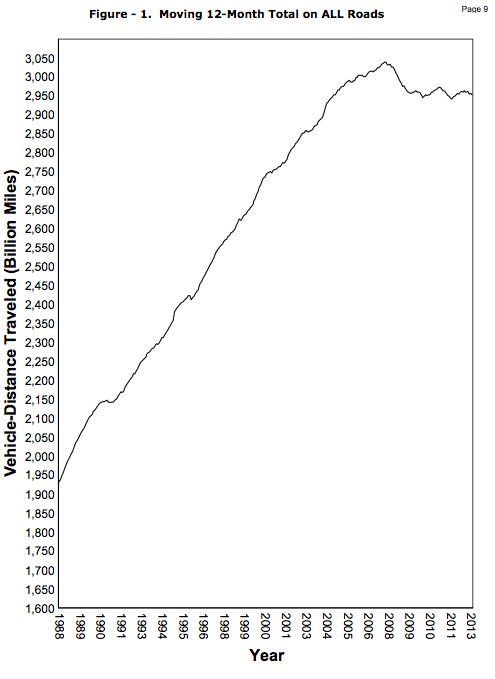
Data through February.
via (pdf) http://www.fhwa.dot.gov/policyinformation/travel_monitoring/13febtvt/13febtvt.pdf
Filed under: Uncategorized | Tags: carbon dioxide emissions, China, Chindia, climate, CO2, Econbrowser, James Hamilton, natural gas liquids, NGLs, oil consumption, Peak Demand, peak oil, total liquids, transportation

And it’s worth remembering why that happened– we didn’t have a choice. Global field production of crude oil (excluding natural gas liquids, which are not used as transportation fuel) stagnated at about 74 million barrels/day between 2005 and 2008. It is up a couple of million barrels since then, but more than 100% of this increase has been consumed by China alone, forcing the U.S. and other countries to reduce our oil consumption.
via James Hamilton: Econbrowser: Declining U.S. carbon dioxide emissions.
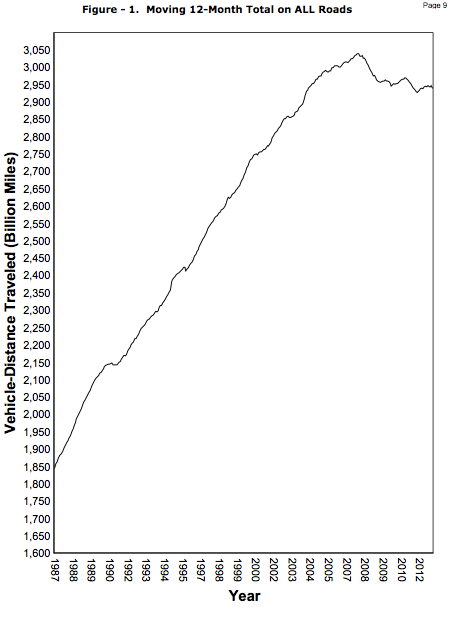
Filed under: Uncategorized | Tags: 2012, driving in the US, oil consumption, Peak Demand, Vmt
via http://www.fhwa.dot.gov/policyinformation/travel_monitoring/12dectvt/12dectvt.pdf
Filed under: Uncategorized | Tags: crude oil, demand growth, demand plateau, energy, OECD, oil consumption, oil demand, oil demand forecast, OPEC, Peak Demand, peak oil
Interesting times.
“Demand in the OECD is in structural decline and we’re not expecting that to change,” he said, adding that the IEA’s forecasts do take into account recent weaker economic activity in the Asia-Pacific region.
According to the report, which contains the IEA’s first forecasts for 2013, global oil demand will be 1.1% higher than 2012, averaging 90.9 million barrels a day.
The forecasts are more bullish than reports earlier this week from the U.S. Energy Information Administration and the Organization of Petroleum Exporting Countries, both of whom projected slower global oil demand growth in 2013 of 730,000 barrels a day and 800,000 barrels a day respectively.
via RIGZONE – IEA: 2013 Oil Demand Growth Higher On Muted Recovery.
Filed under: Uncategorized | Tags: cars, DOT, dot gov, energy, FHWA, oil consumption, oil demand, Peak Demand, transportation, United States, vehicle miles traveled, Vmt
+ 1.8% Over Feb. 2011…
Moving 12-month total.
http://www.fhwa.dot.gov/policyinformation/travel_monitoring/12febtvt/12febtvt.pdf

Filed under: Uncategorized | Tags: 7 sisters, de Margerie, energy, IEA forecast for 2012, Jon Thompson, Lee Raymond, oil demand, oil production, Peak Demand, peak oil, Total, XOM, Yergin
Interesting piece by Andrew McKillop.
At the current time there is no sign that either of these Nice Theory solutions coming about in the real world, unless we try the conspiracy theory that the OECD group, led by the US, Europe and Japan voluntarily sabotaged their economies in 2008 – to save oil !
Annual growth of oil demand by China, India, Bangladesh, Pakistan, Brazil, Turkey and other nonOECD, large population, oil importing industrialising countries could hit as much as 1.75 Mbd each year, under 2004-2007 global economic conditions. Not even 2 years of that growth would send oil prices right off the top of the graph. Even with continued slow oil demand growth by the OECD group, or recession-driven decline of their demand … global oil demand can easily bounce.
…
We can simply note that dependable Peak Oil denial from playful flyweights like Dan Yergin or oil industry stalwarts like former CEO Lee Raymond and E&P chief Jon Thompson of ExxonMobil, or Christophe de Margerie of Total has problems staying on track. The real bottom line on global oil production is increasingly heard: world oil output will very likely never achieve more than around 90 Mbd on a short-life basis, before terminal decline sets into operation. The only upside is that necessarily more expensive shale oil, and necessarily expensive GTL (oil from gas) may smooth the downslope.
Today’s IEA forecast for global average daily demand in 2012 is about 89.9 Mbd.
via The Magical Decline Of Crude Oil Demand :: The Market Oracle
Filed under: Uncategorized | Tags: denial, economics, energy, joules, Peak Demand, peak oil, physics, thermal energy, Tom Murphy, waste heat
Or, My Dinner With Andre the Giant Economist.
Another fun bit from Tom Murphy. Shades of Plato’s Republic.
…The upshot is that at a 2.3% growth rate (conveniently chosen to represent a 10× increase every century), we would reach boiling temperature in about 400 years. [Pained expression from economist.]
via Exponential Economist Meets Finite Physicist | Do the Math.
The economist says he believes that energy will become “arbitrarily cheap” in the future, before realizing how stupid that is.
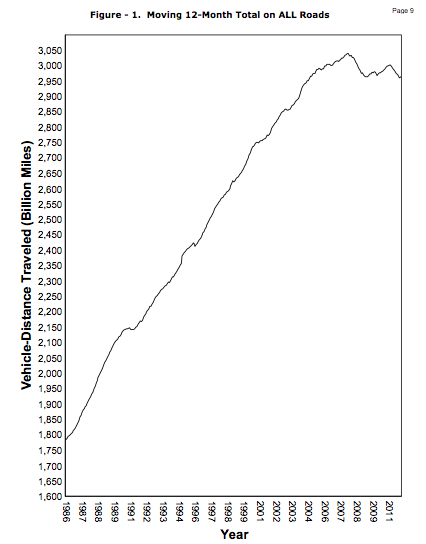
Filed under: Uncategorized | Tags: albatross, Brent, crude oil, fuel costs, gas prices, gasoline, Jevon's Paradox, Peak Demand, Peak Everything, peak oil, vehicle miles traveled, Vmt, WTI
VMT (Vehicle Miles Traveled) up slightly in December relative to last December, but down overall for the year, and below its previous peak now for 49 months. With fuel prices on the rise it doesn’t look like it will break above that for quite some time — if ever.
But what do I know.. People are buying cars again. It’s Halftime in America and “the SUV is back.”
From the DOT:
Filed under: Uncategorized | Tags: consumption, energy, energy consumption, energy demand, IEA, International Energy Agency, oil demand, Peak Demand, peak oil, petroleum
IEA forecasts flat global oil demand for 2012.
http://www.rigzone.com/news/article.asp?a_id=114374&hmpn=1

Filed under: Uncategorized | Tags: Colin McInnes, energy, Peak Demand, Peak Energy, peak oil, Richard Henberg, The End of Growth
Economic growth: it’s not dead yet | Colin McInnes | spiked.
In this bit McInnes argues that economic growth can continue after Peak Oil — citing as evidence all the wonderful engineering which occurred in the cheap oil era and which depended on cheap oil for its existence. I find his argument less persuasive and more simplistic than the ‘doomer’ arguments he is criticizing.
 Industrialized Cyclist Notepad