


Filed under: Uncategorized | Tags: Fukushima, nuclear accident, nuclear disaster, radiation, Tepco, typhoon, Wipha
via ex-skf: http://ex-skf.blogspot.com/2013/10/large-and-strong-typhoon-no26.html
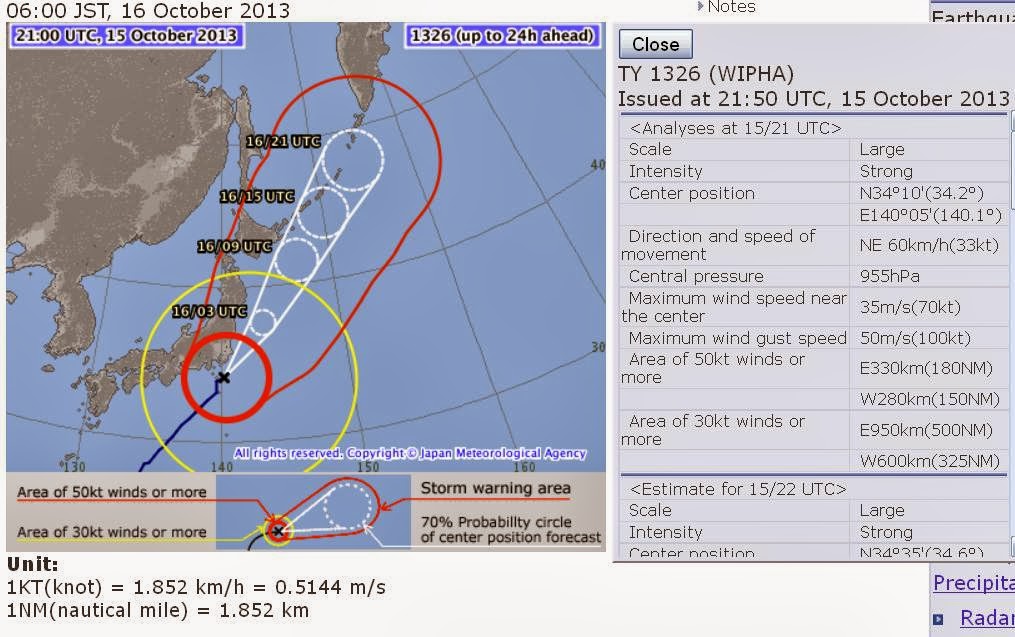
click to enlarge
Sorry about the ad below if there is one and sorry about the fact that the spent fuel pool might blow over in the typhoon and make the northern hemisphere uninhabitable.
Filed under: Uncategorized | Tags: Air pollution, black carbon, dirt clod, energy, industrial emissions, ozone, ozone concentrations, particulate, PM-2.5, tailpipe, transportation
Via MIT. Looking at 2005:
… Total combustion emissions in the U.S. account for about 200,000 (90% CI: 90,000–362,000) premature deaths per year in the U.S. due to changes in PM2.5 concentrations, and about 10,000 (90% CI: −1000 to 21,000) deaths due to changes in ozone concentrations. The largest contributors for both pollutant-related mortalities are road transportation, causing ∼53,000 (90% CI: 24,000–95,000) PM2.5-related deaths and ∼5000 (90% CI: −900 to 11,000) ozone-related early deaths per year, and power generation, causing ∼52,000 (90% CI: 23,000–94,000) PM2.5-related and ∼2000 (90% CI: −300 to 4000) ozone-related premature mortalities per year. Industrial emissions contribute to ∼41,000 (90% CI: 18,000–74,000) early deaths from PM2.5 and ∼2000 (90% CI: 0–4000) early deaths from ozone. The results are indicative of the extent to which policy measures could be undertaken in order to mitigate the impact of specific emissions from different sectors — in particular black carbon emissions from road transportation and sulfur dioxide emissions from power generation.
 Industrialized Cyclist Notepad