


Filed under: Uncategorized | Tags: Clean Air Act, directional drilling, EPA, fracking, green completions, horizontal drilling, hydraulic fracturing, methane, Natural gas, shale gas, shale plays, tight gas, tight oil, VOCs
From an EPA press release:
During the first phase, until January 2015, owners and operators must either flare their emissions or use emissions reduction technology called “green completions,” technologies that are already widely deployed at wells. In 2015, all new fractured wells will be required to use green completions. …
An estimated 13,000 new and existing natural gas wells are fractured or re-fractured each year. As those wells are being prepared for production, they emit volatile organic compounds (VOCs), which contribute to smog formation, and air toxics, including benzene and hexane, which can cause cancer and other serious health effects. In addition, the rule is expected to yield a significant environmental co-benefit by reducing methane, the primary constituent of natural gas. Methane, when released directly to the atmosphere, is a potent greenhouse gas—more than 20 times more potent than carbon dioxide.
I’ll keep the line above as it was typed into the page’s description by some agency PR person, because that alone tells you all you need to know about the EPA.
Filed under: Uncategorized | Tags: carbon, energy, fracking, methane, methane leakage, Natural gas, natural gas production, PNAS, radiative forcing, shale gas
Alvarez, Pacala, Winebrake, Chameides and Hamburg, “Greater focus needed on methane leakage from natural gas infrastructure,” Proceedings of the National Academy of Sceinces of the United States of America, 2012.
Full article: http://www.pnas.org/content/early/2012/04/02/1202407109.full.pdf+html
Filed under: Uncategorized | Tags: Cheniere, energy, fracking, hydraulic fracturing, liquefied natural gas, LNG, Natural gas, natural gas exports, shale gas, tight gas
Energy independence? Not so much.
The government may decide as soon as next week on Cheniere’s request to build a $10 billion Louisiana plant that would be the largest in the U.S. to liquefy gas and load it onto ocean-going tankers. Regulators will discuss the project April 19. Cheniere’s shares rose as much as 11 percent in New York.
via LNG Export Plant Verges on U.S. Approval Amid Shale Glut – Bloomberg.
Filed under: Uncategorized | Tags: agriculture, Colorado River, Colorado River Basin, fracking, H2O, hydraulic fracturing, Northern Water Conservancy District, water auctions
Farmers lose.
The Northern Water Conservancy District runs the auction, offering excess water diverted from the Colorado River Basin—25,000 acre-feet so far this year—and conveyed through a 13-mile tunnel under the Continental Divide.
Filed under: Uncategorized | Tags: Citi, Citigroup, energy, fracking, hydraulic fracturing, oil price predictions, oil supply, oil supply predictions, peak oil
Citi analysts have been calling an end to America’s energy problems and for the appearance of a 900-foot-tall golden unicorn named Darren.

Filed under: Uncategorized | Tags: Alaska, deepwater, energy, fracking, GOM, Gulf of Mexico, horizontal drilling, hydraulic fracturing, North Slope, Prudhoe Bay, shale gas, tight gas, tight oil, unconventional oil
From EIA. Prudhoe Bay also “reversed the decline in domestic oil production” at one point.
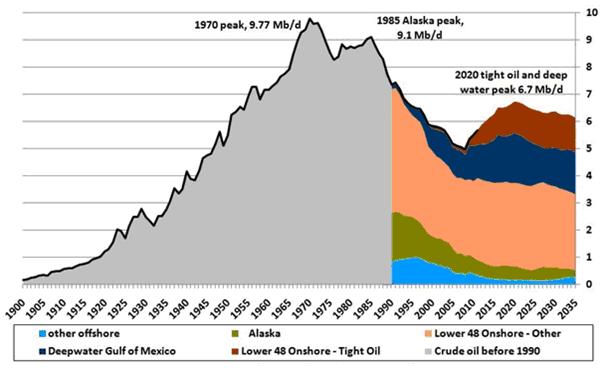
click to enlarge
Filed under: Uncategorized | Tags: Baker Hughes, drilling rigs, Early Warning, energy, fracking, gas production, Natural gas, oil production, Staniford
via Stuart Staniford’s Early Warning:
http://earlywarn.blogspot.com/2012/03/us-rig-count-trends.html

Filed under: maps | Tags: Bakken, Barnett Shale, Eagle Ford, energy, energy production, fracking, hydraulic fracturing, Marcellus, Niobrara, oil production, Piceance Basin, shale gas, shale oil, tight gas, tight oil
Via EIA.

click to enlarge
Filed under: Uncategorized | Tags: fracking, hydraulic fracturing, Marcellus, Pennsylvania, Pennsylvania fracking law, shale gas, shale oil, tight gas, tight oil, Tom Corbett
And the public at large of course. “Non-disclosure agreement.” According to this report anyway.
… If a company does release information about what is used, health care professionals are bound by a non-disclosure agreement that not only forbids them from warning the community of water and air pollution that may be caused by fracking, but which also forbids them from telling their own patients what the physician believes may have led to their health problems. A strict interpretation of the law would also forbid general practitioners and family practice physicians who sign the non-disclosure agreement and learn the contents of the “trade secrets” from notifying a specialist about the chemicals or compounds, thus delaying medical treatment.
The clauses are buried on pages 98 and 99 of the 174-page bill, which was initiated and passed by the Republican-controlled General Assembly and signed into law in February by Republican Gov. Tom Corbett.
via Fracking: Pennsylvania Gags Physicians | Truthout.
Filed under: Uncategorized | Tags: Badger Daylighting, COGC, EOG Resources, fracking, fracking waste, Garden Creek 7-14H, Garden Creek O7-14H, Grove, hydraulic fracturing, radioactive fracking sand, radioactive fracking waste, radionucleides, Weld County, WTF
With articles like this, you’ve got to wonder.
Hydraulic fracturing involves the use of millions of gallons of water, chemicals and sand.
Occasionally, some of that sand is radioactive.
Oh. You don’t say.
The state is investigating a possible inappropriate dumping of fracking-related radioactive sand into an unpermitted pit at an EOG Resources oil well in northern Weld County northwest of Grover.
The radioactive sand dumping occurred March 8 during a state field inspection of an oil well known as the Garden Creek 28-07H well, the Coloradoan’s search of state oil well inspection records revealed.
via State investigating radioactive sand dumping related to fracking | The Coloradoan | coloradoan.com.
Filed under: Uncategorized | Tags: COGC, Colorado Oil and Gas Commission, drilling regulations, EOG Resources, fracking, fracking sand, Garden Creek 07-14H, Niobrara, oil production, radioactive fracking sand, tight oil, Weld County
A sensitive area due to shallow groundwater. According to a site assessment, groundwater is 20 feet below the surface.
http://ogccweblink.state.co.us/results.aspx?id=415806

Filed under: Uncategorized | Tags: brine, earthquakes, fracking, fracking waste, hydraulic fracturing, ODNR, Ohio, seismic events, waste-water injection, Youngstown
Linked by too-strong circumstantial evidence.
The 12 Youngstown quakes, ranging in magnitude from 2.1 to 4.0, all occurred in a cluster less than a mile from the well and about 2,500 feet below the well itself, according to the Ohio Seismic Network, a division of the ODNR.
The quakes began in March 2011, just three months after the well went into operation. The last quake occurred on Dec. 31, a day after the ODNR has ordered – and then watched – the shutdown of the well. State geologists and regulators had inspected the well 35 times from April 26 to Dec. 15, trying to connect the quakes with the injections.
“Geologists believe it is very difficult for all conditions to be met to induce seismic events,” the report noted. But “a number of coincidental circumstances appear to make a compelling argument for the recent Youngstown-area seismic events to have been induced.”
via Waste-water injection well caused 12 earthquakes in Ohio, investigation shows | cleveland.com.
Filed under: Uncategorized | Tags: Big Gas, Big Oil, Boone Pickens, Club for Growth, energy, frack, fracking, Koch Brother, Natural gas, peak oil, Peak Oil is dead, s
Kochs don’t like govt. picking winners and losers — especially if the losers are them.
The idea of using the tax code to spur conversion of trucking fleets has support from many Democrats and Republicans, and enjoys some powerful backers.
They include billionaire energy magnate T. Boone Pickens, Reid and President Obama, who touted his own natural-gas vehicles plan in a Wednesday speech. (A White House spokesman couldn’t be reached for comment on the Senate proposal specifically.)
But groups influential in GOP circles including Heritage Action (an arm of the Heritage Foundation), the Club for Growth, Americans for Tax Reform and Americans for Prosperity have long been battling the natural-gas plan.
via Natural-gas tax fight between Koch, Pickens reaches Senate floor – The Hill's E2-Wire.
Filed under: Uncategorized | Tags: Cove Point, energy, fracking, hydraulic fracturing, LNG, LNG exports, natural gas exports
East Coast LNG import facility will probably be changed to an export facility. This development results in higher prices for American consumers, while our water gets fracked. In contrast — it is illegal to export crude oil produced in the US.
Dominion, based in Richmond, Va., has won approval from the Department of Energy to use Cove Point for exporting liquefied natural gas to about 20 nations with which the United States has free-trade agreements. The company is now seeking federal permission to allow shipments to virtually any foreign country, except those barred because of trade embargoes.
via Marcellus shale fracking: Natural gas exports eyed through Calvert County – Baltimore Sun.
Filed under: Uncategorized | Tags: brine, Cooperstown, frac, fracing, fracking, fracking brine, fracking waste, hydraulic fractuing, Love Canal, Pittsfield, radionucleides
There is some poetic justice there.
According to the agency’s website, state regulations give the DEC “jurisdiction over waste material which is to be beneficially used.”
The spreading of gas brine in Pittsfield by a firm called Al-Kleen Inc. of Earleville was permitted by the DEC in 2010, according to state records.
Filed under: Uncategorized | Tags: frac, frack, fracking, No Fracking Way, protest, Tour Down Under
Now see if I didn’t just describe this here video.
Not too often that we run across something with both fracking and bike content.
Filed under: maps, Uncategorized | Tags: Carrizo Springs, Eagle Ford, energy, energy production, fracking, fracking and water, hydraulic fracturing, Natural gas, shale gas, shale oil, shale plays, Texas Railroad Commission, tight gas, tight oil, WSJ

via http://online.wsj.com/article/SB10001424052970204528204577009930222847246.html
Filed under: Uncategorized | Tags: Eagle Ford, frack, fracking, Texas Railroad Commission, water consumption
According to http://www.rigzone.com/news/article.asp?a_id=114624&hmpn=1
But check the math. The figures below come from the article.
— 540,000 acre feet in the aquifer when the fracking began.
— 30,000 acre feet per year used by fracking at peak demand.
— fracking supposedly accounts for only 6% of total aquifer usage. Agriculture takes 65%.
This implies that the entire aquifer would be consumed within a few years.
Even if the frack water amounted to 25% of water usage, the aquifer would be gone in under five years. I have seen claims of up to 40% frack water usage in S. Texas — if that’s true, and the other figures are true, the aquifer would be gone in seven or eight years.
In any case, something’s not adding up here.
Filed under: Uncategorized | Tags: Baker Hughes, Bakken, Eagle Ford, energy, frack, fracking, hydraulic fracturing, Marcellus, Natural gas, natural gas production, proppant, tight gas, tight oil
…a.k.a. proppant. Didn’t see that one coming, Baker Hughes didn’t either apparently.

 Industrialized Cyclist Notepad