


Filed under: Uncategorized | Tags: bitumen, Canada, Canadian oil production, China, CNOOC, heavy oil, Nexen, oil sands, Petroliam Nasional, Petronas, Progress, Stephen Harper, Suncor, tar sands, unconventional oil
Canadian Prime Minister Stephen Harper approved Cnooc Ltd. (883)’s $15.1 billion takeover of Nexen Inc. (NXY) and Petroliam Nasional Bhd.’s C$5.2 billion ($5.2 billion) takeover of Progress Energy Resources Corp. (PRQ)
via Canada Approves Both Cnooc-Nexen, Petronas-Progress Deals – Bloomberg.
Filed under: Uncategorized | Tags: Boeing, Boing, Deadman's Party, drone aircraft, Drones, hush kit, Hush!, Insitu, Oingo Boingo, ScanEagle, surveillance drone, unmanned aerial vehicles
I’ll take one with the Hush Kit, for “undetectable low altitude flying.” And you could put just about anything you want in the payload bay…as long as it’s not too heavy. This is a small aircraft:
Performance
Endurance: 24+ hours
Ceiling: 19,500 ft / 5,944 m
Max horizontal speed: 80 knots / 41 m/s
Cruise speed: 48 knots / 25 m/s
System features
Propulsion: 1.9 hp (1.4 kw), 2-stroke engine
Fuel: Gasoline (100-octane, unleaded, non-oxygenated gas) or heavy fuel (JP5, JP8, Jet-A)
Navigation: GPS / Inertial
Launch: Pneumatic catapult
Recovery: SkyHook wing-tip capture
Dimensions
Wingspan: 10.2 ft / 3.11 m
Length: 4.5 ft / 1.37 m
Weights
Empty structure weight: 28.8 lb / 13.1 kg
Max takeoff weight: 44.0 lb / 20.0 kg
Upgrades
– AIS for maritime domain awareness
– Heavy fuel engine with 28 hours endurance
– Hush engine for reduced acoustic signature
– Mid-wave IR sensor for increased nighttime resolution – Mode C Transponder for aircraft deconfliction
– ROVER support
via the ScanEagle Product Card (pdf): http://www.insitu.com/images/uploads/product-cards/ScanEagle_SubFolder_UE_092612.pdf
via http://www.insitu.com/systems/scaneagle
The Iranians say they captured one of these things.
The ScanEagle is an “off the shelf” spy plane manufactured by Insitu, a unit of U.S.-based Boeing. The company also supplies and operates drones for customers in several Middle Eastern countries, including to help ensure oil platform security in the Gulf, according to its website.
The U.S. military has been using the ScanEagle spy planes since 2004 and they have become a relatively inexpensive way for the United States and others to conduct surveillance.
Jill Vacek, a spokeswoman for Boeing subsidiary Insitu, said the company had built 1,685 of the aircraft. Other military customers include Canada, Australia, Poland, the Netherlands, Singapore, Malaysia, and Japan, as well as “other U.S. Department of Defense customers,” she said.
via Iran says it captures drone; U.S. denies losing one | Reuters.
Filed under: Uncategorized | Tags: 2012, 2019, AEO table browser, EIA, energy, Hubbert, oil predictions, oil production, peak oil, U.S. crude oil production
7.54 mbd of crude in 2019. According to the EIA’s “AEO Table Browser:”
AEO Table Browser – Energy Information Administration.
See also: THE AMAZING RED MOUND, BAKKEN DEVELOPMENT BY COUNTY, EPA FRACKING AIR POLLUTION RULES, MONTANA CRUDE OIL PRODUCTION, LIVESTOCK IN FRACKING REGIONS
Filed under: Uncategorized | Tags: bicycle accident statistics, bicycle accidents, bicycling, car-bike crashes, cycling, cycling injuries, fatality rates, Fatality risk, Great Britain, journal of epidemiology, journal of epidemiology and community health, Mindell, modal risk, OP33, pedestrian accident statistics, pedestrian risk, suburban cycling, transportation, travel modes, urban cycling
Mindell, Lesley, Wardlaw. “Exposure-based Assessment of Modal Travel Risk in England Using Routine Health Data,” Journal of Epidemiology and Community Health, September 13, 2012.
Young male drivers appear to have a higher fatality risk than cyclists in England. This is latched onto as quite good news for cyclists. The results of this study depend entirely on responses given on Britain’s National Travel Survey.
Results: Fatalities per million hours’ use (f/mhu) varied little (0.15–0.45f/mhu by mode for men, 0.09–0.31f/mhu for women). Risks were similar for men aged 21–49 years for all three modes and for female pedestrians and drivers aged 21–69 years. The group most at risk for each mode were: male drivers aged 17–20 years (1.3f/mhu, 95% CI 1.2, 1.4); male cyclists aged 70 years or older (2.2 f/mhu, 1.6, 3.0) and female pedestrians aged 70 years or older (0.95 f/mhu, 0.86, 1.1). In general, fatality rates were substantially higher amongst males than females, except for drivers aged 60 years or older. Risks per hour for male drivers under 30 years were similar or higher than for male cyclists; for 17–20 year olds the risk was higher for drivers (33/Bn km, 95% CI 30, 36; 1.3f/mhu, 1.2, 1.4) than cyclists (20/Bn km, 10, 37; 0.24f/mhu, 0.12, 0.45) using distance or time.
Abstract: http://jech.bmj.com/content/66/Suppl_1/A13.2
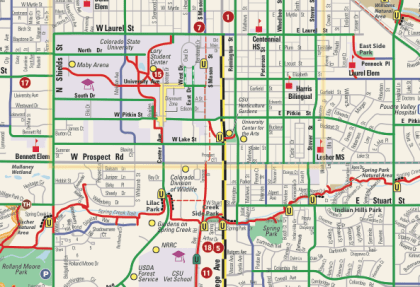
Filed under: maps | Tags: Aggies, bicycle, bicycle transportation, bicycling, bike map, bike paths, bike routes, cycling infrastructure, Fort Collins, Rams, urban cycling
http://www.fcgov.com/bicycling/pdf/bike-map-front.pdf
Filed under: Uncategorized | Tags: Arctic Ocean, energy trade, Finnmark County, icebreakers, Japan, Japanese LNG imports, LNG, LNG trade movements, Melkoya, Natural gas, northern route, Ob River, sea ice, shipping routes
First time…
Gas tanker the “Ob River” took the cargo aboard at Melkøya, Finnmark County, on 7 November. The ship is now lying outside one of Japan’s major LNG terminals in Japan waiting to unload 134,738 cubic metres of liquefied natural gas.
[…]
He estimates the sailing season in the north lasts from the very end of July to the first half of November.
via Arctic Ocean gets first gas cargo – Aftenbladet.no.
Filed under: Uncategorized | Tags: air pressure, air resistance, bicycle tech, bicycling, contact patch, cycling, gradient resistance, gravity, mountain biking, optimal air pressure, pedaling resistance, resistance force on a bicycle, rolling resistance, Schwalbe, tire deformation, tire size, tire width, urban cycling
From the Schwalbe tech info pages — http://www.schwalbetires.com/tech_info/rolling_resistance

Filed under: Uncategorized | Tags: advanced fuels, ARPA-E, DOE, energy grants, energy projects, money, public funding
Here: http://arpa-e.energy.gov/Portals/0/Documents/Projects/OPEN2012_ProjectDescriptions_FINAL_112812.pdf
See where the money is being thrown for energy research on ‘advanced fuels.’
Filed under: Uncategorized | Tags: Ahoy, Avast!, backstroke, CH4, F'NG, FLiNG, FLNG, George H. W. Bush, green, green gas, liquified natural gas, LNG, Michael Phelps, Natural gas, natural gas production, offshore Australia, OMG, Royal Dutch Shell, Shell, swimming, talk like a pirate, WHOA, zero hedge
Floating Liquified Natural Gas Facility (FLNG).

click to enlarge
Shouldn’t that be FLNGF? Don’t pretend there’s no F-word on the end. Wouldn’t all of our acronyms be so much better if we could just make up the rules as we go along.
Developed after 10 years of research, using 600 engineers, and 1.6 million man-hours (182.5 years equivalent), Shell has manged to compact the size of a traditional LNG plant to a quarter of its land size. As Wired explains: “by stacking components vertically and using deep-sea water to cool the gas to its liquid state, the FLNG saves dramatically on deck space and enables the whole facility to occupy an area of roughly 4 football pitches: 28,500 square meters. One of its most innovative features involves the the plant’s unique location: an assembly of eight one-meter diameter pipes will extend 150m below the ocean’s surface, delivering around 50 million liters of cold seawater an hour, used to cool the gas.”
via http://www.zerohedge.com/news/2012-12-02/fling-aint-what-it-used-be
Filed under: Uncategorized | Tags: ambient air testing, Bakken, Benzene, butane, chloride, chloroform, chromium, drill pad, fracking fluid, fracking wastewater, Marcellus, methane, North Dakota, propane, Schilke, shale gas, shale oil, strontium, sulfates, toluene, well testing
After drilling began just over the property line of Jacki Schilke’s ranch in the northwestern corner of North Dakota, in the heart of the state’s booming Bakken Shale, cattle began limping, with swollen legs and infections. Cows quit producing milk for their calves, they lost from 60 to 80 pounds in a week and their tails mysteriously dropped off. Eventually, five animals died, according to Schilke.
Ambient air testing by a certified environmental consultant detected elevated levels of benzene, methane, chloroform, butane, propane, toluene and xylene – and well testing revealed high levels of sulfates, chromium, chloride and strontium. Schilke said she moved her herd upwind and upstream from the nearest drill pad.
via Livestock falling ill in fracking regions | Center for Investigative Reporting.
From February:
The Pennsylvania farmers I spoke with have lost cows, calves, a horse, a couple dozen chickens. Many of the animals succumb in the same way: seizure-like symptoms, gasping for breath and a quick wasting away. A Rottweiler and a Dalmatian also fell ill and died.
Gives new meaning to the term ‘tail risk.’
 Industrialized Cyclist Notepad