


Filed under: Uncategorized | Tags: 2012, driving in the US, oil consumption, Peak Demand, Vmt
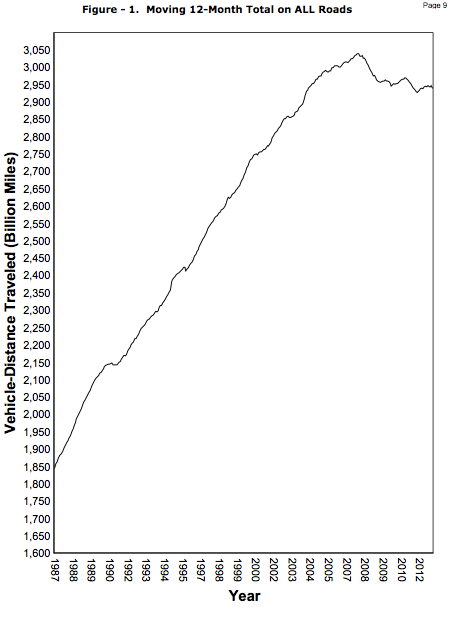
via http://www.fhwa.dot.gov/policyinformation/travel_monitoring/12dectvt/12dectvt.pdf
Filed under: Uncategorized | Tags: Alice Cooper, API, Eighteen, energy, oil demand, peak oil, petroleum demand, US oil consumption
18-year low oil demand. 18 million barrels per day.
18 and I like it.
U.S. Oil Demand Fell to 18-Year Low for January, API Says – Bloomberg.

Filed under: Uncategorized | Tags: Adelaide, bicycle accidents, bicycling, car-bike collisions, cycling safety, two-wheeled hellions, urban cycling
Drivers in Adelaide, according to a study of police reports there:
T-intersections were the most dangerous locations for crashes, followed by straight roads, and signalled intersections.
Drivers were at fault in 79 per cent of crashes and cyclists 21 per cent.
via Four in every five crashes between cars and bicycles caused by driver of car | adelaidenow.
Will this knowledge finally spark the crackdown on scofflaw cyclists that we so desperately need to finally cease any and all terrorizing of little old ladies by these unabashed two-wheeled hellions? Let us pray.
Filed under: maps, Uncategorized | Tags: crude oil supply, Cushing, EIA, energy, oil pipelines, oil transportation, petroleum products, pipeline map, refineries, US oil production, WTI

Via EIA:
This Week In Petroleum Summary Printer-Friendly Version.
Filed under: Uncategorized | Tags: conspicuity, high-vis, looked but failed to see, urban cycling
Helman, Weare, Palmer and Fernandez-Medina, “Literature review of interventions to improve conspicuity of motorcyclists and help avoid ‘looked but failed to see’ accidents,” 2012.
A really nice overview of motorcyclist conspicuity studies, with this nugget at the very end:
Special thanks are due to Cris Burgess for reviewing an earlier draft of this report. During the period of time when reviewing the draft, Cris was riding his motorcycle to work and was struck from behind by a bus. Thankfully, Cris sustained only minor injuries in the collision. The irony of the fact that at the time of the collision he was wearing a bright orange high-visibility jacket, and riding a motorcycle with daytime running lights, is not lost on the authors.
Using lights during the day, wearing hi-vis clothing, helps. It does not work reliably, however, as the effectiveness of the extra measure(s) will depend very much on the background and other aspects of the immediate environment, which are constantly changing.
Filed under: Uncategorized | Tags: Brent, crude oil, Cushing, James Hamilton, peak oil, Seaway pipeline, spread, WTI

click to enlarge
Blue is Brent, black is WTI, green is the spread between them.
A relatively recent phenomenon explained by James Hamilton:
West Texas Intermediate is a particular grade of crude oil whose price is usually quoted in terms of delivery in Cushing, Oklahoma. Brent is a very similar crude from Europe’s North Sea. As similar products, you’d expect them to sell for close to the same price, and up until 2010 they usually did. But an increase in production in Canada and the central U.S. combined with a decrease in U.S. consumption has led to a surplus of oil in the central U.S. This overwhelmed existing infrastructure for cheap transportation of crude from Cushing to the coast, causing a big spread to develop between the prices of WTI and Brent.
via Econbrowser: Prices of gasoline and crude oil.
Filed under: Uncategorized | Tags: Basso, doping, EPO, Fuentes, Jaksche, pro cycling, Puerto, TDF, Tour de France
Jaksche said it was “riders who always end up paying.”
“Cycling is not a mafia, it’s a sport run by unscrupulous people,” he said. “Now the same people who were behind doping would later point their finger at us.”
via VeloNews: Jaksche leaves no doubt in Puerto testimony; Basso says he never transfused blood.
There are some ads appearing on this blorg. I didn’t put them there. I didn’t even know they were there until a few days ago. It’s a WordPress thing. They now charge 30 bucks a year for a no-ad blog. Sorry.

Filed under: Uncategorized | Tags: bicycling, Dorner, ex-cop, fugitive, Livestrong, murders, urban cycling
Via BikinginLA:
In an attempt to justify his actions, Dorner posted a rambling online manifesto (trust me, you’re better off with the Cliff Notes version) in which he professes his support for Tim Tebow, Charlie Sheen, Dave Brubeck’s Take Five and Michelle Obama’s bangs. Not to mention his love and admiration for a long list of female performers, and his thanks to unnamed individuals for some great and not-so-great sex over the years.
Oh, and a list of those deserving of death at his hands.
But surely, anything that long and convoluted has to mention bikes somewhere, right?
Dorner does not disappoint.
Near the end of his meandering philippic, he vents his spleen on those of us who take to two wheels.
Cyclist, I have no problem sharing the road with you. But, at least go the f—— [semi-edited obscenity] speed limit posted or get off the road!!! That is a feasible request. Livestrong you fraudulent a–holes.
…
Filed under: Uncategorized | Tags: bicycle traffic laws, bicycling, cycling laws, Idaho stop, jaywalking, makes too much sense, stop as yield, urban cycling
The Denver Post editorial board (which has not always projected clear-headedness on bike issues) looks kindly at Aspen stop-as-yield, while not exactly embracing it for Denver. Notes that widespread jaywalking hasn’t caused any catastrophic rips to be torn in the space-time continuum:
Certainly there are busy intersections where the stop-as-yield rule won’t work. But the same can be said for jaywalking.
As much as you might argue that pedestrians should obey signs in crosswalks, the truth is there are many times where it’s simply unnecessary or impractical. (Denver’s 16th Street Mall and its numerous cross streets during non-rush periods come to mind.)
We’ve long supported a share-the-road philosophy when it comes to cars and bikes. But that doesn’t mean automobiles and bicycles have to share the same traffic laws if more sensible alternatives exist.
via Let bicyclists in Aspen treat stop signs as yields – The Denver Post.
Why would it make any difference if an intersection is busy or if it’s deserted? The same principle applies regardless. If there is cross traffic, stop and wait. If it’s clear enough to ride across without violating another road user’s right-of-way, go.
A huge majority of Denver’s cyclists ride this way already.
Filed under: Uncategorized | Tags: Aspen, bicycling in Aspen, Idaho stop, ski town cycling, urban cycling
Some officials are recommending that Aspen adopt the Idaho stop.
Aspen Assistant Police Chief Bill Linn said the “stop-as-yield approach” has proven to work in states such as Idaho, which changed its law allowing cyclists the option to yield some 30 years ago. A 2008 study by a University of California at Berkeley researcher showed that in Idaho, police and motorists have accepted the measure as public policy that makes sense. Boise, which has a large percentage of regular bicyclists compared with motorists, has become safer as a result of the change, the study concluded.
via Cyclists might be allowed to yield instead of stopping in Aspen | AspenTimes.com.
Inexplicable burst of rationality.
Filed under: Uncategorized | Tags: bicycle, bicycling, Black Hawk, Colorado, traffic law, urban cycling
The court ruled Monday the town can pass traffic regulations, but said they must comply with state laws that require any municipal bike prohibition provide an available alternate path within 450 feet.
via Colorado court rules against Black Hawk, saying bicycles are a state interest – The Denver Post.
Filed under: Uncategorized | Tags: Bloomberg New Energy Finance, Business Council for Sustainable Energy, carbon dioxide, carbon emissions, CO2, CO2 production, oil consumption, renewable energy, US oil consumption, Vmt
Carbon dioxide emissions fell by 13% in the past five years, because of new energy-saving technologies and a doubling in the take-up of renewable energy, the report compiled by Bloomberg New Energy Finance (BNEF) for the Business Council for Sustainable Energy (BCSE) said.
via US carbon emissions fall to lowest levels since 1994 | Environment | guardian.co.uk.
Nah. It’s because we’re driving less. Look at the VMT chart. The drop in emissions is mainly due to the bad economy, not renewable energy.
Filed under: Uncategorized | Tags: blood doping, doping, EPO, Fuentes, industrialized sports, levantana, Operacion Puerto, Puerto, Spain, Tygart
On Tuesday, Fuentes openly admitted his client list included other sports beyond cycling, naming athletics, tennis, soccer and even boxing.
On Wednesday, Fuentes offered to name all of his clients, saying that he remembered every codename as well as indicating he had a ledger locked away in a safe back on the Canary Islands.
When attorneys representing WADA and CONI both pressed Fuentes for more names, the judge hit the brakes.
There was no anti-doping law on the books during the May 2006 raids and Spanish courts have refused to widen the legal net to anything beyond questions of endangering public health, which could result in minor fines, suspended jail terms and the suspension of medical licenses for Fuentes and his sister.
That interpretation has infuriated many who view the Puerto case as nothing more than a farce.
via VeloNews: Operacion Puerto judge restricting case to health issue.
But at least that cat’s out of the bag, which must make some people extremely uncomfortable: Doping exists in all high-level sports when it provides an advantage. Doping is the hallmark of industrialized sports, where the pursuit of big money and self-preservation of careers by those in the front office is placed far above any sort of integrity, and the health of individual athletes doesn’t even register as anything other than a business concern.
EDIT: Of course I understand that individual athletes choose (more or less) to use these substances for their own selfish reasons. But these athletes are just trying to make childhood dreams come true. And the athletes are the only individuals to suffer consequences from doping. The industry hiding behind them, the UCI officials, team coaches, owners, managers, and sponsors never seem to face any real consequences for the doping that they also profit upon (other than the occasional out of court settlement to a pissed off rider). The worst dopers are wearing suits, not lycra.
Filed under: Uncategorized | Tags: bicycle, bicycle safety, bicycling, bike safety, cycling, mandatory helmet laws, Maryland, urban cycling
Would require helmets for adults on bicycles.
Filed under: Uncategorized | Tags: doping, doping in sports, Fuentes, Hamilton, industrialized sports, Puerto, Tugboat, Tyler Hamilton
In testimony later Tuesday, Fuentes said he had worked [with/on/up] athletes in “all kinds” of sports.
“I worked with individual sportspersons… of all kinds,” he said.
via Velonews: Hamilton official Puerto witness; Fuentes admits working with athletes across sports.
Should we poke that hornets’ nest? There is no culture of lying about doping in pro soccer, because those guys never get asked about it.
I don’t want to hear some wingback swear on the soul of his dead dog that he’s clean.
Filed under: Uncategorized | Tags: Bakken, fracking, health care costs, shale gas, shale oil, tight gas, tight oil, Watford City
A less obvious form of corporate welfare.
The furious pace of oil exploration that has made North Dakota one of the healthiest economies in the country has had the opposite effect on the region’s health care providers. Swamped by uninsured laborers flocking to dangerous jobs, medical facilities in the area are sinking under skyrocketing debt, a flood of gruesome injuries and bloated business costs from the inflated economy.
via Boom in North Dakota Weighs Heavily on Health Care – NYTimes.com.
This post is an interesting companion to the one below.
Filed under: Uncategorized | Tags: Bakken, CH4, fracking, horizontal drilling, Natural gas, natural gas flaring, North Dakota, oil production, shale oil, taxes, tight gas, tight oil
Rampant waste and environmental degradation have been part of the Bakken boom. The state doesn’t care about that, but it wants its taxes.
Helms estimates that about 30% of the gas produced in the state is flared, since development of takeaway infrastructure has not matched the pace of drilling.
Producers are currently allowed to flare gas for a year without paying royalties. The new bill would extend that tax-exempt period for two more years if an operator can collect at least 75% of the produced gas.
via N. Dakota tax bills pique industry interest – Upstreamonline.com.
Filed under: Uncategorized | Tags: blood bags, cycling, doping, EPO, Vaughters
Tweet from Vaughters:
@Vaughters: @Velo_Vicar So common, that during my time as a rider on a div 1 team, I cannot think of any div1 rider who never doped, outside of Bassons.
That Was Then, This is Now. So clean now. Blood so pure.
Filed under: Uncategorized | Tags: Dr. Martin Luther King, Holder, I have a dream, I have a drone, inauguration, inauguration day, MLK, mlk day, National Propaganda Radio, National Public Radio, reality check
This has been your post-MLK/Inauguration Day reality check.

