


Filed under: Uncategorized | Tags: "shutdown", EIA, energy, government shutdown, oil, oil prices
Leaving a void of energy propaganda.
Impact of the federal government shutdown on EIA ›
As a result of the lapse in appropriations for the U.S. Energy Information Administration, the EIA.gov website and our social media channels will not be updated after 1:00 p.m. Eastern Time on Friday, October 11, 2013. Transactions submitted via the website might not be processed until appropriations are enacted; databases might not be available; and we will not be able to respond to inquiries.
Will the shutdown affect EIA\’s reports and data releases? Yes. The release of all reports and data will cease during the shutdown.
via U.S. Energy Information Administration (EIA).
Filed under: Uncategorized | Tags: butane, energy, gas prices, gasoline, NGLs, RVP, transportation, vapor pressure
Blending butane into gasoline is why gas prices fall in the fall, according to Robert Rapier. RVP = Reid vapor pressure, the higher the RVP the faster the evaporation. EPA sets limits on RVP of gasoline which are more stringent in summer months than in winter, allowing the increased blending of cheap, yet highly evaporative (word?) butane:
Butane has an RVP of 52 psi, which means pure butane is a gas at normal pressures and temperatures. But butane can be blended into gasoline, and its fractional contribution to the blend roughly determines its fractional contribution to the overall vapor pressure of the mixture. As long as the vapor pressure of the total blend does not exceed normal atmospheric pressure (again, ~14.7 psi) then butane can exist as a liquid component in a gasoline blend.
But with a vapor pressure as high as 52 psi, butane can’t make a large contribution to summer blends where the vapor pressure limit is 7.8 psi. For example, if a gasoline blend contained 10 percent butane, butane’s contribution to the vapor pressure limit is already 5.2 psi and you would still have 90 percent of the blend to go. It isn’t feasible to blend much butane into gasoline when the vapor pressure requirement is low. But when the limit increases by 5 or 7 psi, it becomes feasible to blend large quantities of butane.
Why do we care about blending butane anyway? Because it is abundant and cheap. Butane can routinely trade at a $1/gallon discount to crude oil or gasoline. Butane is a byproduct of oil refining, but is also a component of natural gas liquids (NGLs), which are condensed out during natural gas production. Given the huge expansion of natural gas production in the US, it should come as no surprise that NGL production is also on the rise.
via Why Gasoline Prices are Falling.
Filed under: Uncategorized | Tags: Carolyn Tucker, Colorado, energy, kerogen, oil, oil shale, peak oil, pie in the ground, proven reserves, Royal Dutch Shell
Said spokesman Martin Skrtel, speaking at Shell’s headquarters in Den Hague, “It was always just a really stupid, non-starter of an idea. You’d have to be a scientific illiterate to believe that cooking “oil shale” to create crude oil could have a positive energy balance. Still, we thought we could buy off enough legislators to create, how should we say, a conducive fiscal atmosphere that would make the scheme a profit-maker for us. But now we have abandoned even those plans…”
Ha ha that was satire. What they really said was different:
A month after Royal Dutch Shell’s U.S. subsidiary said it would pursue its oil shale research project in Colorado while selling off other oil and gas assets, the company has reversed its decision.
“There’s been a shift in our oil shale project,” spokeswoman Carolyn Tucker said Tuesday.
“The energy market has evolved since Shell first started its oil shale research project in 1981. We plan to exit our Colorado oil shale research project in order to focus on other opportunities and producing assets in our broad global portfolio,” she said in an email.
“Our current focus is to work with staff and contractors as we safely and methodically stop research activities at the site,” she said.
The announcement regarding the closure of Shell’s oil shale research and development work comes as the company announces plans to put its assets on the market across the United States, including oil and gas assets in northwestern and southeastern Colorado.
Shell on Aug. 1 reported a 60 percent drop in second-quarter results — largely due to a $2 billion write-down of its North American shale assets due to “the latest insights from exploration and appraisal drilling results and production information.”
via Shell pulling out of Colorado oil shale research project – Denver Business Journal.
Filed under: Uncategorized | Tags: Colorado, driving, energy, gasoline consumption, Great Recession, transportation, Vmt
Just like everywhere else…
DENVER – A new report from the Colorado Public Interest Research Foundations shows Coloradans have cut their per-person driving miles by 11.4 percent since 2005.
via Report: Double-digit drop in driving in Colorado | 9news.com.
Since 2005. But is it headed back up compared to last year?
Filed under: Uncategorized | Tags: Brent crude, energy, North Sea, offshore oil production, oil production, peak oil, UK
Long peaked, declining rapidly and getting really expensive.
The sharp decline in production of oil and gas from under British waters is “worrying” industry leaders.
Trade body Oil and Gas UK says there is record investment this year of £13.5bn.
But its annual report on the industry’s economic impact highlights the sharp fall in output of 19% during 2011 and 14% in 2012.
It says the industry’s latest estimates of the continuing decline suggest a further fall of at least 8.5% during this year, with no recovery next year.
[…]
Because of challenging geology and unplanned shutdowns on offshore platforms, the unit cost per barrel for extracting oil from British waters, known as the UK Continental Shelf (UKCS), has gone up four-fold over the past decade.
via BBC News – 'Worrying' decline in oil and gas production.
Filed under: Uncategorized | Tags: energy, Peak Car, Peak Driving, Peak Motorization, peak oil, Sivak, transportation
It’s not about efficiency.
Has Motorization in the US Peaked? Part 2 — Sivak (pdf).

Filed under: Uncategorized | Tags: crude oil, demand, EIA, energy, energy use, gasoline, jet fuel, oil consumption, Peak Demand, peak oil, products supplied, US oil consumption
Via EIA Week in Review.
Total products supplied over the last four-week period averaged about 19.7 million barrels per day, up by 3.7 percent from the same period last year. Over the last four weeks, motor gasoline product supplied averaged over 9.0 million barrels per day, up by 3.3 percent from the same period last year. Distillate fuel product supplied averaged 4.0 million barrels per day over the last four weeks, up by 11.1 percent from the same period last year. Jet fuel product supplied is 1.6 percent higher over the last four weeks compared to the same four-week period last year.
Filed under: Uncategorized | Tags: energy, light vehicle sales, Peak Demand, peak oil, SAAR, transportation
via Calculated Risk:

Filed under: Uncategorized | Tags: crude oil, Egypt, energy, oil exports, oil production, peak oil
via Energy Export Databrowser:

Filed under: Uncategorized | Tags: Brent, crude oil, Cushing, energy, Keystone pipeline, North Sea, oil prices, WTI
West Texas Intermediate crude became more expensive than Brent for the first time in almost three years as pipeline and rail shipments helped clear a bottleneck that reduced the price of the U.S. benchmark.
WTI hadn’t been higher than Brent since Aug. 17, 2010. The move was in intraday trading. WTI averaged $17.47 less than Brent in 2012 and traded as much as $23.44 lower than its European counterpart Feb. 8.
Improved pipeline networks and the use of rail links are helping to ease the North American oil glut created by rising production of crude from shale formations. WTI has jumped 18 percent this year, while Brent has decreased 2.5 percent as North Sea supplies stabilized after maintenance.
via WTI Crude Exceeds Brent for First Time in Almost Three Years – Bloomberg.
Filed under: Uncategorized | Tags: Burkholder, energy, Lac-Magentic, liquid propane, LNG, oil transportation, propane, trains
He said it appears that the train derailed at the curve and slammed into railroad cars carrying liquid propane. He said a Lac-Megantic resident, a “rail fan” who monitors activity at the yard, told him that he saw four propane cars Friday on the same storage track.Burkholder would not name his source, but said the Lac-Megantic resident had given accurate information about train movements in the past.He said liquid propane is transported under pressure and is more likely than crude oil to create the kind of explosion that destroyed much of downtown Lac-Megantic. Crude oil is not transported under pressure, he said.Burkholder said aerial photographs show that the vast majority of the tank cars carrying oil remain “intact and solid.””Its very clear that the oil train itself didnt crash and blow up,” he said. “Its what it crashed into.”
via Propane suspected in Canada explosions | The Portland Press Herald / Maine Sunday Telegram.
Filed under: Uncategorized | Tags: air cargo, air traffic, air travel, aviation, economic activity, economics, energy, jet fuel, peak oil, recession, transportation
Trending down.

Via Macronomics:
Macronomics: Air Traffic is pointing to additional economic activity weakness.
Filed under: Uncategorized | Tags: Bakken, crude oil, energy, IEA, IEA forecast, OECD, oil price predictions, oil supply, OPEC, peak oil, refining capacity, shale oil, tight oil
IEA… Not a good track record with the predictions. Doesn’t stop ’em from throwing out new crazy numbers every year.
While geopolitical risks abound, market fundamentals suggest a more comfortable global oil supply/demand balance over the next five years. The MTOMR forecasts North American supply to grow by 3.9 million barrels per day (mb/d) from 2012 to 2018, or nearly two-thirds of total forecast non-OPEC supply growth of 6 mb/d. World liquid production capacity is expected to grow by 8.4 mb/d – significantly faster than demand – which is projected to expand by 6.9 mb/d. Global refining capacity will post even steeper growth, surging by 9.5 mb/d, led by China and the Middle East.
via IEA – May:- Supply shock from North American oil rippling through global markets.
Filed under: Uncategorized | Tags: carbon, carbon credits, Chris Martenson, CO2, coal, energy, LNG, natural gas exports, Obama, peak oil
Chris Martenson, smart about energy, busts the O administration for its disingenuous claims about lowering carbon emissions with natural gas:
To claim credit for lowered carbon emissions due to natural gas and then also support the idea of exporting LNG (where fully 25% of the base energy is combusted in order to simply liquefy the product) is hypocritical. These are two ideas that work against each other. Either you use natural gas wisely and efficiently as you move away from coal resources and claim a carbon credit for these actions, or you support throwing 25% of natural gas’ energy right into the atmosphere just to cool it for transport.
So it’s a fallacy to imply that exporting natural gas will help lower carbon emissions. In all honesty, total emissions will most likely be higher than otherwise – because let’s be realistic; the most likely path is for humanity to burn up all the natural gas and then burn up the coal next.
Further, where the U.S. carbon emissions have gone down due to less coal being burned, that happy circumstance resulted in Europe doing exactly the opposite:
[…]
Does natural gas help to lower carbon emissions? No, it merely pushes the carbon emissions elsewhere while the U.S. feasts on relatively cheap natural gas domestically. The only thing that lowers carbon emissions is NOT burning coal, natural gas, or petroleum – collectively.
via The Obama Administration's Policy on LNG Makes No Energy Sense | Peak Prosperity.
Filed under: Uncategorized | Tags: BP, energy, Esso, Jamaica, Jamaica Aircraft Refuelling Services, jet fuel, Montego Bay, Petrojam, Sangster International Airport, St. James, Total, transportation
Earlier this week.
Highly placed police sources have confirmed that more than 200,000 litres of jet fuel has been stolen from the Sangster International Airport in Montego Bay, St James.
The fuel, valued at $20 million, is owned by a consortium, including Jamaica Aircraft Refuelling Services (partnership between PetroJam and British Petroleum), Esso and Total.
Filed under: Uncategorized | Tags: Aramco, energy, KSA, Naimi, peak oil, Prince Faisal, Saudi Arabia, Saudi Arabian oil consumption, Saudi Oil Minister, Saudi oil production, Saudi production capacity
Even in a totalitarian government they can’t get their stories together.
“Saudi Arabia’s national production management scheme is set to increase total capacity to 15 million barrels per day and have an export potential of 10 [million] barrels per day by 2020,” Prince Faisal, a former Saudi ambassador to the US and UK said in a speech at the Belfer Centre for Science and International Affairs of Harvard University. The speech was delivered last week and posted on the centre’s website late Monday.
The prince clarified his position in an email on Tuesday. “Saudi consumption may reach five million barrels of oil by then [2020], hence the production capacity of fifteen million barrels,” is required to maintain country’s export potential, he said.
Saudi Arabia would be lucky to go past production of 9 million barrels a day by 2020 and, “we don’t see anything like 15 million barrels a day before 2030, 2040,” said Naimi in an appearance at the Centre for Strategic and International Studies in Washington DC Tuesday.
via Rift emerges over Saudi oil policy | GulfNews.com.
Notice in this article and others how any potential increase or decrease in Saudi oil production is always portrayed as a matter of policy, not geology.
Filed under: Uncategorized | Tags: energy, gas-electric, hev, hybrid, oil consumption, phev, Prius, transportation
Unimpressed with their cars’ performance and m.p.g. for the money. Still, hybrids are gaining popularity overall.
According to industry reports, only about one in three hybrid owners buy another gas-electric model when they trade in.
via Hybrid sales increase, but some eco-drivers are disappointed – Business on NBCNews.com.
Filed under: Uncategorized | Tags: energy, gasoline production, Peak Demand, peak oil, transportation, US oil consumption, vehicle miles traveled, VMT< DOT
No coherent explanation for the way the years are labeled across the bottom however.
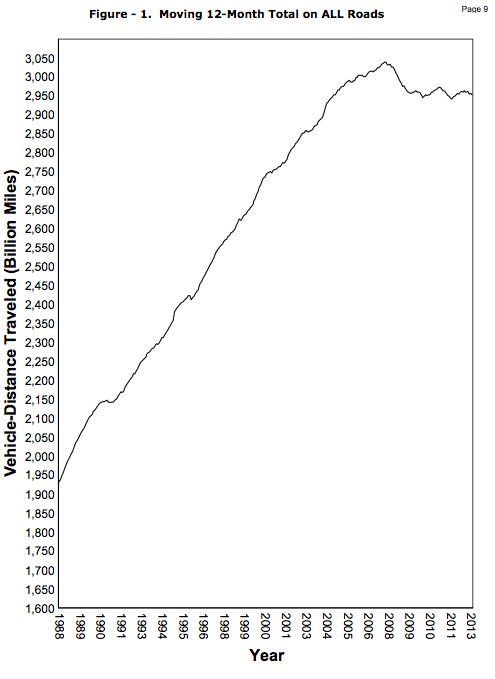
Data through February.
via (pdf) http://www.fhwa.dot.gov/policyinformation/travel_monitoring/13febtvt/13febtvt.pdf
Filed under: Uncategorized | Tags: energy, fuel prices, gas prices, gasoline, pain at the pump, petrol
The long view.

click to enlarge
Filed under: Uncategorized | Tags: climate change, CO2, coal, coal-fired plants, emissions, energy, EPA, EPA rule, greenhouse gases, Natural gas
…on that whole renewable energy thing, let alone make real changes.
WASHINGTON – The Environmental Protection Agency said Friday that it would delay issuance of a new rule limiting emissions of carbon dioxide and other greenhouse gases from new power plants after the electric power industry objected on legal and technical grounds.
The rule, proposed a year ago and scheduled to be finalized on Saturday, would have put in place the first restrictions on climate-altering gases from the power sector in the United States. Agency officials said it would be rewritten to address the concerns raised by the industry, which said that strict new carbon standards could not be met using existing technology.
via E.P.A. to Delay Emissions Rule at New Power Plants – NYTimes.com.
If we did start moving in the right direction, people would complain bitterly about the ‘inconveniences’ caused.
 Industrialized Cyclist Notepad