


Filed under: Uncategorized | Tags: california, energy, gasoline supply, transportation
Gasoline station owners in the Los Angeles area including Costco Wholesale Corp. (COST) are beginning to shut pumps because of supply shortages that have driven wholesale fuel prices to record highs.
Costco’s outlet in Simi Valley, 40 miles (64 kilometers) northwest of Los Angeles, ran out of regular gasoline yesterday and was selling premium fuel at the price of regular, Jeff Cole, Costco’s vice president of gasoline, said by telephone. The company hasn’t been able to find enough unbranded summer-grade gasoline to keep its stations supplied, he said.
via California Gas Stations Begin to Shut on Record-High Spot Prices – Bloomberg.
Filed under: Uncategorized | Tags: energy, peak oil, transportation, urban cycling, vehicle miles traveled, Vmt
Interesting times, exhibit 67.
Via http://www.fhwa.dot.gov/policyinformation/travel_monitoring/12jultvt/index.cfm

Filed under: Uncategorized | Tags: cars, EIA, energy, Energy Information Association, gas stocks, gasoline, stocks, transportation
U.S. stocks of finished gasoline, via EIA.

click to enlarge
Filed under: maps | Tags: bubbling, bubbling sites, CH4, energy, LA, louisiana, Louisiana sinkhole, methane, Natural gas, sink hole
via (pdf) http://www.edsuite.com/proposals/proposals_280/bubble_map_9-7-12_fi_430.pdf
The Louisiana sinkhole.

Filed under: Uncategorized | Tags: China, Chinese coal production, climate, CO2 production, coal, EIA, energy, global coal production, global warming, peak oil
The rise in global production over the past decade is almost entirely due to Chinese production…
via the EIA via http://www.theoildrum.com/node/9485

Filed under: Uncategorized | Tags: BP, deepwater drilling, energy, GOM, holding station, Hurricane Isaac, jackups, oil production, oil supply, peak oil, platforms, rigs, shut in, Transocean, US oil production
Updated August 30. Almost all of Gulf shut down.
Based on data from offshore operator reports submitted as of 11:30 a.m. CDT today, personnel have been evacuated from a total of 509 production platforms, equivalent to 85.4 percent of the 596 manned platforms in the Gulf of Mexico. Production platforms are the structures located offshore from which oil and natural gas are produced. Unlike drilling rigs, which typically move from location to location, production facilities remain in the same location throughout a project’s duration.
Personnel have been evacuated from 50 rigs, equivalent to 65.79 percent of the 76 rigs currently operating in the Gulf. Rigs can include several types of self-contained offshore drilling facilities including jackup rigs, submersibles and semisubmersibles.
via BSEE Hurricane Isaac Activity Statistics: August 30, 2012 | BSEE.
Filed under: Uncategorized | Tags: Athabasca Oil Sands, bitumen, Canada, Canadian oil sands, China, CNOOC, energy, foreign control of tar sands, Foreign Investment Review Act, Jeff Rubin, Nexen, oil production, oil sands, PetroChina, Petronas, syncrude, tar sands, unconventional oil
Recall that American consumers are (strongly) encouraged to think of Canadian production as domestic production.
CNOOC’s blockbuster deal for Nexen, if nothing else, is a stark indication of how far the goal posts have moved not only for Canada’s oil patch, but also for world oil demand. Only four or five years ago, the notion that a state-owned Chinese company could buy—lock, stock and barrel of bitumen—one of Canada’s premier oil names was politically unthinkable. Any such deal was sure to be turned down by Ottawa under its Foreign Investment Review Act (not to mention the hue and cry that would come from Alberta’s provincial government).
Today, that’s all changed. CNOOC’s $15-billion offer for Nexen follows a number of major foreign transactions in Canada’s energy sector. Among others, Malaysian energy giant Petronas is paying $5.5-billion to get at Progress Energy’s natural gas reserves in British Columbia. Earlier this year, PetroChina completed a two-pronged deal for Athabasca Oil Sands Corp. that tallied $2.5-billion. In 2010, Sinopec paid $4.65-billion for a 9 percent stake in Syncrude, which runs Alberta’s largest oilsands mine.
via CNOOC’s Nexen Bid Shows How Far Goal Posts Have Moved | Jeff Rubin.
Filed under: Uncategorized | Tags: DOT, energy, extrapolations, government estimates, peak oil, s, transportation, vehicle miles traveled
I have no idea. Just throwing that out there as a question.
I do know that quantifying the total amount of driving that has occurred on “all roads” by an entire population is necessarily a dark art, prone to wild extrapolations.

Currently not falling off a cliff, according to DOT.
via (pdf) http://www.fhwa.dot.gov/policyinformation/travel_monitoring/12maytvt/12maytvt.pdf
Filed under: Uncategorized | Tags: Calvert Cliffs, Constellation, Electricite de France, energy, Exelon, high neutron flux, Limerick nuclear plant, Nine Mile, nuclear energy, nuclear power, Oconee, reactor, reactor core
Constellation Nuclear Energy Group’s 630-megawatt Nine Mile Point 1 nuclear reactor in New York automatically shut on Tuesday due to high neutron flux — meaning neutrons are not equally spread around the reactor core. Power traders guessed it could have been a faulty sensor and the unit could be back soon.
Constellation Nuclear is a venture between French power company Electricite de France SA (EDF) and Chicago power company Exelon Corp.
A unit at Exelon’s Limerick nuclear plant in Pennsylvania shut early Wednesday, according to power traders. Officials at the company and the U.S. Nuclear Regulatory Commission could not confirm the Limerick shutdown.
Constellation Nuclear 855-MW took the Unit 1 at the Calvert Cliffs nuclear plant in Maryland offline by early Wednesday due to a small leak in an instrument line. The company said it had already fixed the plant and was ramping up the unit.
North Carolina-based Duke Energy’s 846-MW Unit 1 at the Oconee nuclear plant in South Carolina also shut by early Wednesday. Details about the Oconee shutdown were not immediately available to comment.
via Four U.S. power reactors shut & NYC sweats during heat wave – CNBC.
Filed under: maps | Tags: aircraft carriers, amphibious warship, crude oil, en route, energy, Iran, middle-east, Persian Gulf, Strait of Hormuz, the Great Game
via http://www.zerohedge.com/news/three-us-aircraft-carriers-now-middle-east-fourth-en-route

click to enlarge slightly
Filed under: Uncategorized | Tags: crude oil, demand growth, demand plateau, energy, OECD, oil consumption, oil demand, oil demand forecast, OPEC, Peak Demand, peak oil
Interesting times.
“Demand in the OECD is in structural decline and we’re not expecting that to change,” he said, adding that the IEA’s forecasts do take into account recent weaker economic activity in the Asia-Pacific region.
According to the report, which contains the IEA’s first forecasts for 2013, global oil demand will be 1.1% higher than 2012, averaging 90.9 million barrels a day.
The forecasts are more bullish than reports earlier this week from the U.S. Energy Information Administration and the Organization of Petroleum Exporting Countries, both of whom projected slower global oil demand growth in 2013 of 730,000 barrels a day and 800,000 barrels a day respectively.
via RIGZONE – IEA: 2013 Oil Demand Growth Higher On Muted Recovery.
Filed under: Uncategorized | Tags: cosmic rays, electromagnetic, energy, GOES, magnetometer, NOAA, solar flares, solar storm
via http://www.solarham.net/magnetogram.htm

Filed under: Uncategorized | Tags: American oil production, crude oil, crude oil production, Econbrowser, energy, James Hamilton, oil production, peak oil, Texas oil production, Texas Railroad Commission, tight oil, transportation, westtexas
A historical perspective.

via Econbrowser and James Hamilton: http://www.econbrowser.com/archives/2012/07/shale_oil_and_t.html
Filed under: Uncategorized | Tags: Bakken, Bakken Shale, crude oil, energy, horizontal drilling, James Hamilton, Jeffrey Brown, marginal costs of production, natural gas liquids, Niobrara, oil price, oil shale, peak oil, shale oil, shale plays, tight gas, tight oil, tight oil formations, unconventional oil, westtexas
Throwing a little cold water on some recent, loudly reported unscientific predictions. When you read Hamilton, always be sure to read the comments by Jeffrey Brown for an important Big Picture view.
In addition to the uncertainties noted above about extrapolating historical production rates, the rate at which production declines from a given well over time is another big unknown. Another key point to recognize is the added cost of extracting oil from tight formations. West Texas Intermediate is currently around $85/barrel. With the huge discount for Canadian and north-central U.S. producers, that means that producers of North Dakota sweet are only offered $61 a barrel. Tight oil is not going to be the reason that we return to an era of cheap oil, for the simple reason that if oil again fell below $50/barrel, it wouldn’t be profitable to produce with these methods. Nor is tight oil likely to get the U.S. back to the levels of field production that we saw in 1970. But tight oil will likely provide a source of significant new production over the next decade as long as the price does not fall too much.
via Econbrowser: Shale oil and tight oil.
Filed under: Uncategorized | Tags: bicycle safety, bicycling, bike, Bike accidents, bike commuting, Bike to Work Day, car versus bike, car-bike collisions, common sense, cycling, denver, energy, Linkhart, looked-but-failed-to-see errors, Mayor Hancock, transportation, urban cycling
He was my favorite mayoral candidate. He has almost no TV charisma, which is a major plus for a public official. He would have made a fine mayor. He liked libraries.
Fortunately, he’s fine, but the incident did prompt a conversation between council members and the mayor about road safety regulations and the interactions between cyclists and vehicles.
…During which, of course, scofflaw bicyclists somehow came out the villains, and education and/or reprogramming of scofflaw bicyclists was re-hurled to the tippy top of the bike safety priority list. This even though Linkhart’s crash (1) did not involve a scofflaw bicyclist and (2) car-bike crashes involving adult bicyclists typically do not. The most likely scenario for an adult bicyclist is to be caught out by another road user’s looked-but-failed-to-see error while riding lawfully. But hey, we’ve all seen bicyclists run lights right? People like Mayor Hancock make no attempt to understand the truth about urban cycling safety. Why bother — everyone knows it’s “common sense.” Common sense is good politics. Let’s not let any facts get in the way of our “common sense” about bicycle safety.
According to Linkhart, he was heading west on 23rd Avenue — on a bike route — approaching Downing Street when a pickup truck went to make a left turn and collided with him.
“I was going straight. He turned left in front of me, and…hit me across the side, and I fell down,” Linkhart recalls.
… Linkhart was scraped up badly, his bike got a bit bent and he had to get several stitches in his leg.
“I kinda went flying,” he said. “I kind of plowed into the sidewalk. I had a helmet, which didn’t help.”
Linkhart, going straight, had the right of way over the pickup truck, which was turning left.
23rd and Downing is classic left cross territory. I’ve been through that intersection a hundred times. Got to ‘keep your head on a swivel’ so to speak.
via Westword Doug Linkhart, ex-councilman, hit while cycling to Bike To Work Day event – Denver News – The Latest Word.
Filed under: Uncategorized | Tags: Chesapeake, Chesapeake Energy, China, energy, energy independence, energy security, Natural gas, shale gas, shale oil, Sinopec Fu Chengyu, tight gas
All part of America’s new ‘energy security.’
Fu Chengyu, chairman of Sinopec Corp, was in Oklahoma last week to explore the possibility of a bid for a shale gas project, which is owned by Chesapeake Energy, the second largest shale gas producer in the US, Reuters reported.
via China's Sinopec eyes shale gas assets in US | China Economic Review.
Filed under: Uncategorized | Tags: cargo, diesel, energy, peak oil, transportation, trucking
Filed under: Uncategorized | Tags: 30 8-K, air travel BP, Anderson, Delta Airlines, energy, jet fuel, peak oil, Trainer refinery, transportation
Yeah, I don’t think so.
“We’re probably the largest private purchaser of jet fuel in the United States but we don’t get to participate in the pricing function,” Anderson told reporters after the Delta’s annual meeting in New York. “It’s our intention to begin to participate in the pricing function and put a lot of downward pressure on the cost of refining a barrel of jet fuel.”
The Trainer refinery will produce 52,000 barrels a day of jet fuel, according to slides published in an April 30 8-K filing by the company. Delta will exchange all other products with BP Plc (BP/) and Phillips 66 (PSX) for an additional 120,000 barrels a day of jet fuel in other locations around the country. The airline consumes about 210,000 barrels a day in the U.S.
via Delta CEO Says Airline to Pressure Prices as Jet Fuel Seller – Bloomberg.
Filed under: maps | Tags: Arab Emirates, crude oil, crude pipeline, Emirates, energy, global crude oil, Habshan-Fujairah, Iran, middle-east, oil production, oil transport, peak oil, Persian Gulf, pipeline, Strait of Hormuz, UAE
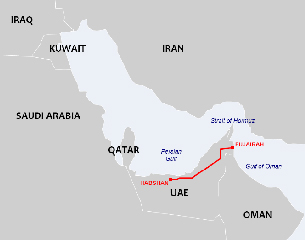
Will help a little bit with the whole Strait of Hormuz thing.
 Industrialized Cyclist Notepad