


Filed under: Uncategorized | Tags: crude oil production, depletion, energy, King, Murray, oil production, peak oil
A new article in Nature acknowledges apparent peak in crude oil supply around 2005, and associated bits of nasty math, including depletion of existing supergiant fields and sharp decline in shale gas wells. Here’s the citation for the article:
http://www.nature.com/nature/journal/v481/n7382/full/481433a.html
Murray and King say “we need to start immediately” to mitigate the effects of Peak Oil. But the effects of Peak Oil are already mitigating us.
via Energy Bulletin:

click to enlarge
Filed under: Uncategorized | Tags: China, consumption, energy, oil demand, peak oil, petroleum demand
…In 2011, was up, but apparently slowing down. The Chinese are using about 9.6 mbd, about half of the American total.
From Rigzone.

Filed under: Uncategorized | Tags: Benzene, broken pipeline, denver, energy, oil sands, peak oil, petroleum, Platte River, refinery, Sand Creek, Suncor, toxic leak
From a new article by Bruce Finley in the Denver Post.
Yes, this is Denver drinking water. They don’t even know where the leak is.

Filed under: Uncategorized | Tags: Darmstadter, energy, energy consumption, HYDE, hydroelectric, liquid fuel, Natural gas, peak oil, power, solid fuel
…by fuel type.
Via HYDE: http://themasites.pbl.nl/en/themasites/hyde/consumptiondata/perfueltype/index.html

Claimed source is Darmstadter, 1971.
Filed under: Uncategorized | Tags: energy, fracking, horizontal drilling, Michael Vaughn, peak oil
Recent production gains in the US have been accompanied by an all-out propaganda assault, from industry and their pocketed pundits and politicians, to convince the public that (1) water-intensive extraction methods are environmentally friendly, and (2) that the new production associated with it is a “game-changer” that will lead to “North American energy independence” and all that. A quick glance at the numbers shows (2) to be a far-fetched notion at best. Still, the propaganda campaign seems to be working.
This is my favorite massive mis-apprehension out of several published mis-apprehensions populating the papers this morning:
“Gas prices are holding steady thanks to the fact that North American production of crude oil is expected to hit an all-time high within the next five years …”
That little un-checked nugget from Michael Vaughn at the Globe and Mail..
Leaving aside the interesting question of whether blatant mis-statements like this, which have presumably survived review by editors of major international publications, are deliberate lies or just lazy stenographic journalism — Is the built-up wall of ignorance now too thick and high to get past? It’s a green monster.
Should we try to break down the wall or is it just much too huge? Should we stand back and admire it in all its glory? Should we paint subversive cartoons on it? What?
Filed under: Uncategorized | Tags: API, Canada, consumption, energy, fracking, imports, oil imports, oil sands, peak oil, petroleum, tar sands
…show US, though producing more and consuming less, still importing over 11 mbd in 2011, with just over 2 mbd from Canada.
Via Oil & Gas Journal.

click to enlarge
Filed under: Uncategorized | Tags: diesel electric, electric trucks, military vehicles, Oshkosh, peak oil
From a presentation (pdf) by Oshkosh.

click to enlarge
Filed under: Uncategorized | Tags: consumption, energy, energy consumption, energy demand, IEA, International Energy Agency, oil demand, Peak Demand, peak oil, petroleum
IEA forecasts flat global oil demand for 2012.
http://www.rigzone.com/news/article.asp?a_id=114374&hmpn=1

Filed under: maps, Uncategorized | Tags: Cantarell, energy, Ku Maloob Zaap, peak oil, Pemex, platform fire
A platform here has burned after a turbocharger caught fire and the well has been shut in, according to reports.

via rigzone: http://www.rigzone.com/news/image_detail.asp?img_id=1811
Filed under: Uncategorized | Tags: demand, EIA, energy, gas consumption, gasoline, oil demand, peak oil, recession, This Week in Petroleum, transportation
From EIA’s This Week in Petroleum.

Filed under: Uncategorized | Tags: energy, energy consumption, gas prices, liquid fuel, oil, peak oil, refineries, U.S. average gas price
Via Calculated Risk.
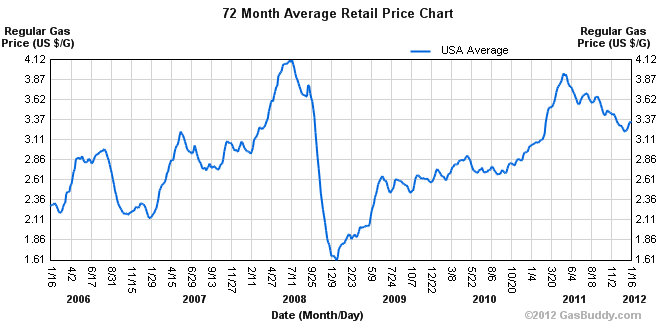
click to enlarge
We almost always ramp up the price in the spring.
Filed under: Uncategorized | Tags: EIA, energy, energy outlook, oil, peak oil, predictions
These projections are looking sillier and sillier in graphic form.
This is what Hope looks like via EIA:

Of course there is also a ditch over on the left side of the graph, which breeds hope for the future among fans of energy use. But we came out of that ditch with Alaskan and N. Sea oil, and more Saudi oil. This time, we expect cooked sand and “tight oil” to pull us out of the total energy ditch?
Filed under: Uncategorized | Tags: Azerbaijan, demand, demand destruction, depletion, OECD, OPEC, peak oil, supply
He said, “Any disappointments on the demand side have on average been outweighed by disappointments on the supply side, and in particular the spectacular deceleration in non-OPEC supply after the first quarter started off on a strong note with non-OPEC supply in January increasing by almost 1 million b/d, continuing the momentum seen across the fourth quarter of 2010.” Despite strong growth in production of unconventional liquids, non-OPEC supply growth virtually ground to a halt. Horsnell blamed underperformance in the North Sea, technical issues in Brazil and Azerbaijan, decline rates in China, fires in Canada, strikes in Kazakhstan, and geopolitical disruptions in Sudan, Yemen, and Syria.
“The only bright spot has been the US where the momentum in oil shales has continued to tick higher, helping offset some of the weakness from the rest of the world,” he said.
via 2011: 'Odd year' for oil – Oil & Gas Journal.
Could be what Peak Oil looks like.
Filed under: Uncategorized | Tags: crude oil, depletion, IEA, oil predictions, peak oil, petroleum, production, Rech
Q: What do you foresee? Let’s begin with the non-OPEC producers (which represent 58% of production and 23% of global reserves).
Rech: Outside OPEC, things are clear: of 40 million barrels per day (mb/d) of conventional petroleum extracted from existing fields, we face an annual decline on the order of 1 to 2 mb/d.
via Oil will decline shortly after 2015, says former oil expert of International Energy Agency | Oil Man.
Roughly 5% annual decline in conventional supply ongoing.
Filed under: Uncategorized | Tags: freedom, fuel subsidies, justice, Lagos, Nigeria, peak oil, protests, Shell, truth
Gas prices more than doubled overnight. There were other frustrations behind the protests, for instance lack of freedom, truth and justice.
Will’s latest offering — “America’s Oil Boom” — seems designed to perpetuate confusion about the export surplus in petroleum products, which Will does not ascribe to economic depression, unemployment and the substantial drop in miles traveled, but to “abundance.” I suspect he misunderstands the issue even as he attempts to obscure it.

He may be right about the insidious nature of “progressives,” whoever they are. But what if there really is energy scarcity. Can Will and his fellow obscurants successfully blame that on “progressives” as well? They’re going to give it a good try.
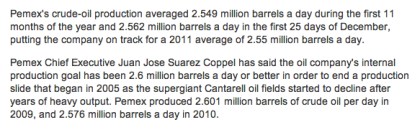
Filed under: Uncategorized | Tags: Cantarell, crude oil, exports, imports, Mexico, oil production, peak oil, Pemex, refining capacity
http://www.marketwatch.com/story/pemex-oil-output-slips-for-7th-year-2011-12-31
Filed under: Uncategorized | Tags: collapse, cornucopianism, Do the Math, limits to growth, peak oil, Tom Murphy
Found myself in strong agreement with this blog post from Tom Murphy.

Filed under: Uncategorized | Tags: Brent, crude oil, Ed Walsh, energy, gasoline, Iran, oil price, peak oil, Tom Keene, WTI
Filed under: Uncategorized | Tags: electricity, peak oil, Saudi Arabia, solar energy
Saudi Arabia is paying a heavy price for its continued reliance on oil to generate electricity. Its power plants consume 800,000 barrels a day of oil equivalent, Ziyad Al Shiha, the executive director of Saudi Aramco Power Systems, told reporters in May. With the price of crude above US$100 a barrel on international markets, the opportunity cost is high, making investments in alternative sources of power more attractive.
via Saudis kicking off major move into solar – The National.
 Industrialized Cyclist Notepad