


Filed under: Uncategorized | Tags: ASPO, crude oil production, EIA, energy, Jeffrey Brown, oil production propaganda, peak oil, production numbers, Railroad Commission of Texas, RRC, Texas, Texas crude oil production, transportation
According to the Railroad Commission of Texas.
http://www.rrc.state.tx.us/data/production/oilwellcounts.php
Some individuals recently noting the difference between RRC and EIA production numbers. From a comment by Jeffrey Brown:
Total US Crude Oil Production (EIA, mbpd):
2002: 5.746
2003: 5.681
2004: 5.419
2005: 5.178
2006: 5.102
2007: 5.064
2008: 4.950
2009: 5.361
2010: 5.476
2011: 5.662Total US Crude Oil Production, using RRC data for Texas, instead of EIA (Gap Between the two data sets):
2002: 5.615 (+131,000 bpd)
2003: 5.548 (+133,000)
2004: 5.303 (+116,000)
2005: 5.059 (+119,000)
2006: 4.948 (+154,000)
2007: 4.898 (+166,000)
2008: 4.813 (+137,000)
2009: 5.199 (+162,000)
2010: 5.285 (+194,000)
2011: 5.324 (+338,000)
http://www.theoildrum.com/node/9191#comment-893345
Filed under: Bike of the Day | Tags: Bridgestone, Bridgestone MB-1, commuter bike, MB-1, shimano deore, The Art of Mountain Biking, transportation, vintage beauty, vintage bicycles
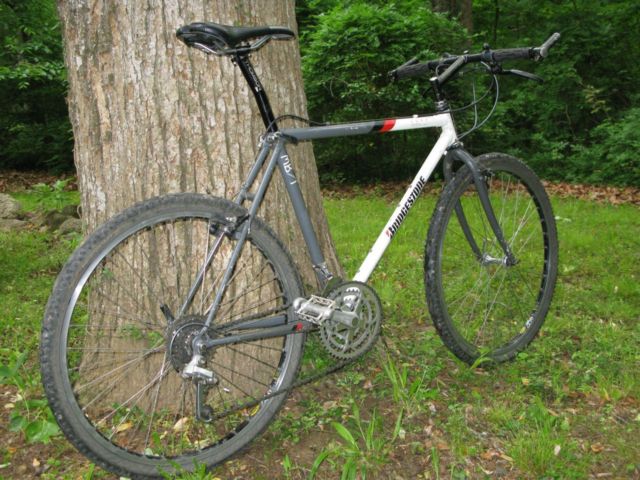
12 hours left on E-Bay.
Keith is in the intro to my new book The Art of Mountain Biking: Singletrack Skills for All Riders. He bought this MB-1 new from Criterium bike shop in 1988, and has been treating it with the utmost respect ever since. Amazingly, this trail-ready vintage beauty could be yours…
Description by Keith:
“Wow” your mountain biking friends by showing up for the next group ride on this vintage, highly coveted classic. This is widely considered the quintessential mountain bike of its day. Revolutionary frame angles, build quality, and components made this perhaps the most advanced racing mountain bike at the time, which is why today this steel bike is coveted by collectors. See Sheldon Brown’s web page on this bike, along with the PDF file of the catalog featuring it.
I am original owner, having bought this from my local Colorado Springs bike shop specified with a Shimano Deore XT group (see parts list below). Selling this is going to break my heart.
Has age-appropriate paint wear and scratches (see photos). Some superficial rust. No dents. Frame, forks, and wheels are straight. Imprecise shifting can be finessed now, but chain, cogs, chainrings, and possibly cables and housing need replacing for smooth, precisely indexed shifting. Everything else works well. One shifter clamp was re-threaded in the early ’90s and has held tight since. One shifter missing the “Shimano Deore XT” face plate (see photo).
1988-1992: used recreationally as a mountain bike in Colorado and California. 1993, 2000-2011: used as a commuter bike in California, Texas, Maryland, and North Carolina almost entirely on pavement. 1994-1999, 2012: stored unused.

Filed under: Uncategorized | Tags: active commuting, active transportation, bicycle, bicycle commuting, bicycling, bike, bike commuting, biking, cycling, gas taxes, transportation
And, it kills your back and hips. Which causes more stress.
The bit below about American cities not being built for active commuters. Not exactly true. Somewhat true. A lot of American cities are currently set up quite nicely to accept vast numbers of additional bike commuters should these autonomous individuals choose to take that step.
A 2011 study of 21,000 Swedish workers found those who commuted by car or public transit reported more stress, exhaustion and missed work days than those who walked or bicycled to work. But few American cities are built for active commuters.
“We’ve engineered physical activity out of our lives,” said Hoehner. “We need to change our communities and make improvements to the infrastructure to make the healthy choice the easy choice.”
via Commuting Drives Up Weight, Blood Pressure – ABC News.
There is a lot more to making a bike-friendly environment than “engineering” the built environment. Like what:
–The cost of driving in Europe is much higher than it is in the US, due to famously high fuel taxes and fees. We complain about 4$ gas. No Euro country has gas anywhere near that cheap, due to govt. fuel taxes.
–Laws and court proceedings in bike-friendly countries favor bicyclists and pedestrians.
–Culture is overall more bike-friendly.
It’s already an easy choice for many in the US. Let’s stop making excuses. There will always be room for improvement. The built environment will never be perfect here, and it isn’t in Europe.
I guess what I’m saying is this. We all wish for improvements in the cycling environment. If you complain about and push for better bike infrastructure, great! That helps. But I sure hope you’re doing it as a bike commuter, not as an excuse-making car commuter.
Filed under: Uncategorized | Tags: bicycle trek, cars, Chief Ward, Florham Park, florham park nj, National Law Enforcement Officers Memorial, Police Unity Tour, Ridgewood, ridgewood nj, transportation, unity tour
When cops ride bikes for any reason, it’s good for bicyclists.
On May 9, the police chief leaves behind the bulletproof vest and paperwork to embark on a 300-mile bicycle trek from Florham Park, NJ to Washington D.C. for the 16th annual Police Unity Tour.
Over 1,400 officers rode last year, raising $1.5 million to maintain the National Law Enforcement Officers Memorial and museum to honor those who gave their lives while on the clock. Over 19,000 names are on the wall. Nine alone have died in the last month.
For Ward, on his third Unity trip, it’s personal.
“I’ve lost a few friends over the years in the line of duty,” he says.
via Police Chief Riding to Remember the Fallen – Ridgewood, NJ Patch.
Filed under: Uncategorized | Tags: cars, DOT, dot gov, energy, FHWA, oil consumption, oil demand, Peak Demand, transportation, United States, vehicle miles traveled, Vmt
+ 1.8% Over Feb. 2011…
Moving 12-month total.
http://www.fhwa.dot.gov/policyinformation/travel_monitoring/12febtvt/12febtvt.pdf

Filed under: Uncategorized | Tags: centerline, centerline miles, FHWA, highway infrastructure, highways, transportation, What the Florida, WTF
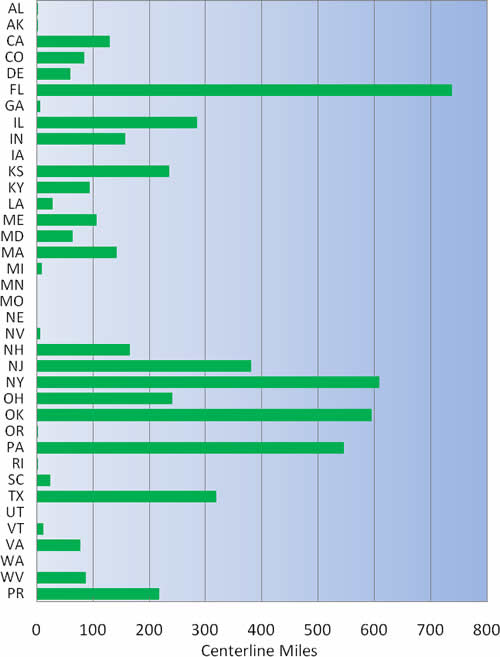
And the western states don’t.
Via http://www.fhwa.dot.gov/policyinformation/pubs/hf/pl11028/chapter1.cfm
Figure 1-7: Toll Road, Bridges, and Tunnels Centerline Miles by State: 2009

Filed under: Uncategorized | Tags: Asian oil demand, Chindia, Chris Nelder, demand destruction, efficiency, energy, fat gets trimmed, fuel efficiency, global oil consumption, OECD, peak oil, transportation
Chris Nelder explains a critical dilemma facing American consumers. As total available oil exports decrease (at a rate that would bring them to absolute zero in about four years), inefficient westerners will be outbid by the new Asian “middle class” for these diminishing supplies.
Of course, exports can fall to zero in theory only, not in practice. In reality, high prices will kill the most inefficient, unsubsidized demand first—in the U.S. and Europe. Next, demand will be curbed in net exporting countries, first via the removal of domestic fuel subsidies, and then by world prices. The demand of the four billion people in Asia will be the last to go because they use it most efficiently.
via Oil demand shift: Asia takes over | SmartPlanet.
Translation: The fat gets trimmed. The fat is here.
Filed under: Uncategorized | Tags: aviation, fuel costs, jet fuel, Patti Smith, Patty Smith, peak oil, transportation
Via LA Times:

Patty Smith, who flew to Los Angeles from Portland, Ore., for a recent vacation, said she saw no empty seats on her Southwest Airlines flight and can’t remember the last time she has had an empty seat next to her on a flight.
“As small as I am, I felt cramped,” said the petite woman as she waited for a taxi from Los Angeles International Airport.
She went home and wrote an angry song about it.
via Airfares climb, routes disappear as fuel prices rise – latimes.com.
Filed under: Uncategorized | Tags: active commuting to school, autism, Boulder, Heatherwood Elementary, Omro Middle School, Safe Routes to School, SRTS, transportation
This school in Boulder apparently has some very cool teachers and parents.
…In just three years, Heatherwood Elementary’s walkers and bicyclists jumped from 12 percent to more than 43 percent of the school.
And, to recognize the importance of including all students in their program, Heatherwood’s SRTS coordinators made a special effort to the school’s autistic children in the district-wide Bike to School Day.
via US DOT official propaganda arm: Colorado’s Heatherwood Elementary and Wisconsin’s Omro Middle School earn 2011 Safe Routes to School Award – Welcome to the FastLane: The Official Blog of the U.S. Secretary of Transportation.
Filed under: Uncategorized | Tags: cng, compressed natural gas, energy, FT-Bh, LNG, Natural gas, Toyota, transportation
The FT-Bh

Filed under: Uncategorized | Tags: Chen Cheng-liang, e-bikes, ebikes, electric bicycles, electric vehicles, Taiwan, transportation
The annual competition has brought forth the latest trends of the industry and has also shown what the bikes of the future might become, the center said recently.
“There has been an obvious growth of popularity in electric bikes,” a spokeswoman of the center said, adding that six of the 19 finalists used such products.
Apart from a smaller motor system, how the battery is concealed in an aesthetic way is also crucial, she added.
The “Velocity,” an urban bike designed by Chen Cheng-liang of Taiwan, for example, has a hidden and detachable power assistance system inside the frame.
via Light electric vehicles, urban bikes foci of design competition | Eco-Business.com.
Filed under: Uncategorized | Tags: bicycle commuting, bicycle transportation, bicycling, bike, bike commuting, bike path, bikeways, biking, Boulder, commuter bikeway, Denver-Boulder, MUP, transportation, US 36
Which is awesome.
The first phase of the project — from Federal to 88th Street — includes:
• Adding an express lane in each direction of U.S. 36, where bus rapid transit and high-occupancy vehicles can travel, free of charge. Solo drivers also will be able to use the express lane by paying a toll, the cost of which will vary by the time of day.
• Reconstructing existing pavement on U.S. 36 and widening the highway to accommodate 12-foot inside and outside shoulders.
• Replacing the Wadsworth Parkway, Wadsworth Boulevard (at West 112th Avenue) and Lowell Boulevard bridges over U.S. 36.
• Installing a separate commuter bikeway along much of the corridor.
via U.S. 36 from Boulder to Denver to get $311 million in improvements – The Denver Post.
Filed under: Uncategorized | Tags: albatross, cash for clunkers, energy, February 2012 SAAR, light vehicle sales, oil consumption, peak oil, SAAR, transportation
via Rortybomb (who took the chart from Calculated Risk). MK is very excited about the auto numbers that came out today.
http://rortybomb.wordpress.com/2012/03/01/auto-sales-surpass-cash-for-clunkers-month/

Filed under: Uncategorized | Tags: auto bailout, bailouts, car dealers, cash for clunkers, channel stuffing, energy, General Motors, GM, Government Motors, inventory, new car inventory, peak oil, transportation
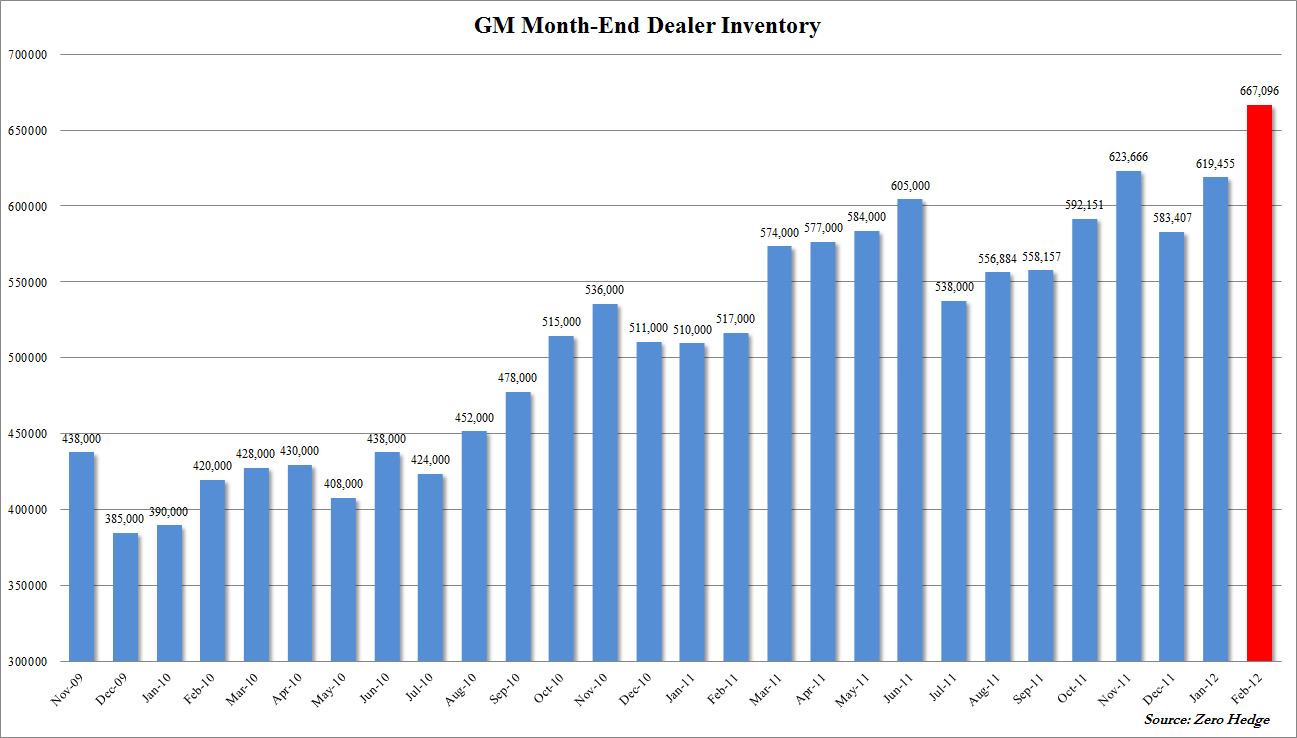
via Zero Hedge:
Filed under: Uncategorized | Tags: Canada, energy, fuel taxes, gas tax, gas taxes, gasoline, oil consumption, oil demand, transportation
In 2010, per liter.

click to enlarge
See also GAS TAXES IN DIFFERENT COUNTRIES
Filed under: Uncategorized | Tags: energy, gasoline, Jevon's Paradox, mustachio'd, oil exports, OPEC, peak oil, porn 'stache, taco time, tacos, thoughtful man, Tom Friedman, transportation, Verleger
That’s what oil exporters do! Yup, we’re going to frack our production up about 200% over its current level, and get more efficient of course, and, of course, “do it right,” and then we’ll start exporting crude to those suckers in Japan and Europe. But first —
But all of this depends on an understanding between the oil industry and the environmentalists. If President Obama could pull that off, it would be a huge contribution to America’s security, economy and environment.
Yeah, that’s it. If we can just come to an understanding with the environmentalists, it’s OPEC time!
Friedman is unbelievably bad sometimes. Other times, believably so.
via http://www.nytimes.com/2012/02/26/opinion/sunday/friedman-a-good-question.html
You may also intensely dislike: THOMAS L. FRIEDMAN IS UNSUSTAINABLE
Filed under: Uncategorized | Tags: average gas prices in US, Barry Ritholtz, energy, gas prices, gasoline supplies, historic gasoline price chart, oil consumption, peak oil, retail prices for gasoline, the Big Picture, transportation
Another look, via Barry Ritholtz’ Big Picture Blog:
http://www.ritholtz.com/blog/2012/02/prices-at-the-pump-on-the-rise/

Filed under: Uncategorized | Tags: autonomous technology, Google, Nevada, robot cars, self-driving cars, traffic, transportation
Uh oh, lookie here. Partner as a verb.
In creating the regulations, the department partnered with Google, automobile manufacturers, testing professionals, insurance companies, universities and law enforcement all with a common vision of saving lives. Several other states currently have bills in front of their legislators that will follow Nevada into the future.
via Regulations Clear the Road for Self-driving Cars.
But, what exactly are these regulations? No word on that.
 Industrialized Cyclist Notepad