


Filed under: Uncategorized | Tags: bicycling, Dorner, ex-cop, fugitive, Livestrong, murders, urban cycling
Via BikinginLA:
In an attempt to justify his actions, Dorner posted a rambling online manifesto (trust me, you’re better off with the Cliff Notes version) in which he professes his support for Tim Tebow, Charlie Sheen, Dave Brubeck’s Take Five and Michelle Obama’s bangs. Not to mention his love and admiration for a long list of female performers, and his thanks to unnamed individuals for some great and not-so-great sex over the years.
Oh, and a list of those deserving of death at his hands.
But surely, anything that long and convoluted has to mention bikes somewhere, right?
Dorner does not disappoint.
Near the end of his meandering philippic, he vents his spleen on those of us who take to two wheels.
Cyclist, I have no problem sharing the road with you. But, at least go the f—— [semi-edited obscenity] speed limit posted or get off the road!!! That is a feasible request. Livestrong you fraudulent a–holes.
…
Filed under: Uncategorized | Tags: bicycle traffic laws, bicycling, cycling laws, Idaho stop, jaywalking, makes too much sense, stop as yield, urban cycling
The Denver Post editorial board (which has not always projected clear-headedness on bike issues) looks kindly at Aspen stop-as-yield, while not exactly embracing it for Denver. Notes that widespread jaywalking hasn’t caused any catastrophic rips to be torn in the space-time continuum:
Certainly there are busy intersections where the stop-as-yield rule won’t work. But the same can be said for jaywalking.
As much as you might argue that pedestrians should obey signs in crosswalks, the truth is there are many times where it’s simply unnecessary or impractical. (Denver’s 16th Street Mall and its numerous cross streets during non-rush periods come to mind.)
We’ve long supported a share-the-road philosophy when it comes to cars and bikes. But that doesn’t mean automobiles and bicycles have to share the same traffic laws if more sensible alternatives exist.
via Let bicyclists in Aspen treat stop signs as yields – The Denver Post.
Why would it make any difference if an intersection is busy or if it’s deserted? The same principle applies regardless. If there is cross traffic, stop and wait. If it’s clear enough to ride across without violating another road user’s right-of-way, go.
A huge majority of Denver’s cyclists ride this way already.
Filed under: Uncategorized | Tags: Aspen, bicycling in Aspen, Idaho stop, ski town cycling, urban cycling
Some officials are recommending that Aspen adopt the Idaho stop.
Aspen Assistant Police Chief Bill Linn said the “stop-as-yield approach” has proven to work in states such as Idaho, which changed its law allowing cyclists the option to yield some 30 years ago. A 2008 study by a University of California at Berkeley researcher showed that in Idaho, police and motorists have accepted the measure as public policy that makes sense. Boise, which has a large percentage of regular bicyclists compared with motorists, has become safer as a result of the change, the study concluded.
via Cyclists might be allowed to yield instead of stopping in Aspen | AspenTimes.com.
Inexplicable burst of rationality.
Filed under: Uncategorized | Tags: bicycle, bicycling, Black Hawk, Colorado, traffic law, urban cycling
The court ruled Monday the town can pass traffic regulations, but said they must comply with state laws that require any municipal bike prohibition provide an available alternate path within 450 feet.
via Colorado court rules against Black Hawk, saying bicycles are a state interest – The Denver Post.
Filed under: Uncategorized | Tags: bicycle, bicycle safety, bicycling, bike safety, cycling, mandatory helmet laws, Maryland, urban cycling
Would require helmets for adults on bicycles.
Filed under: Uncategorized | Tags: Aichi, bicycle accident statistics, bike-car crashes, brakeless, brakeless fixies, cycling accidents, FARS, fixed gear, Japan, Osaka, Saitama, Tokyo, track bikes, urban cycling
The number of cyclist fatalities in Japan last year.
According to the data, there were 633 fatal bicycle accidents last year, with most occurring in Saitama, Tokyo, Aichi and Osaka prefectures.
via Police recommend safety training for reckless cyclists ‹ Japan Today: Japan News and Discussion.
Filed under: Uncategorized | Tags: Art of Cycling, art of urban cycling, Energy Benchmarking reports, energy efficiency, energy use in large buildings, EPA, Greener Greater Buildings Plan, LEED, NYC, NYC Finance, plaza, Seagram Building, urban cycling
As part of the Greener, Greater Buildings Plan, Finance is required to publish a benchmarking report that shows the Energy Utilization Index (EUI) and Energy Star ratings of city government buildings.
via NYC Energy Benchmarking Reports.
The Seagram Building (1958) scored a 3. Out of 100. I wrote a paragraph about this influential building in Art of Cycling.
Filed under: Uncategorized | Tags: 2011, bicycling, cyclist fatalities, cyclist injuries, FARS, NHTSA, traffic accidents, urban cycling
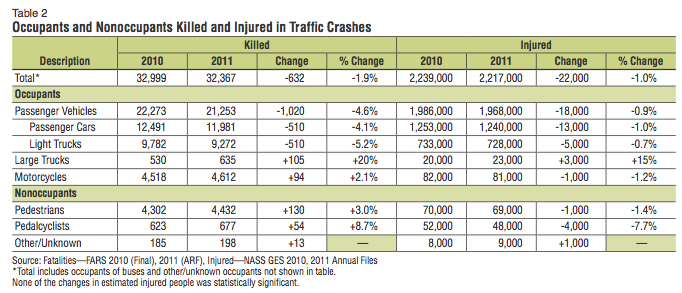
Significantly more bicyclists killed in car-bike crashes, significantly fewer injured in car-bike crashes… Does this make some kind of sense?
click to enlarge
via NHTSA 2011 Motor Vehicle Crashes Overview (pdf): http://www-nrd.nhtsa.dot.gov/Pubs/811701.pdf
Filed under: Uncategorized | Tags: bicycle accident statistics, bicycle accidents, bicycling, car-bike crashes, cycling, cycling injuries, fatality rates, Fatality risk, Great Britain, journal of epidemiology, journal of epidemiology and community health, Mindell, modal risk, OP33, pedestrian accident statistics, pedestrian risk, suburban cycling, transportation, travel modes, urban cycling
Mindell, Lesley, Wardlaw. “Exposure-based Assessment of Modal Travel Risk in England Using Routine Health Data,” Journal of Epidemiology and Community Health, September 13, 2012.
Young male drivers appear to have a higher fatality risk than cyclists in England. This is latched onto as quite good news for cyclists. The results of this study depend entirely on responses given on Britain’s National Travel Survey.
Results: Fatalities per million hours’ use (f/mhu) varied little (0.15–0.45f/mhu by mode for men, 0.09–0.31f/mhu for women). Risks were similar for men aged 21–49 years for all three modes and for female pedestrians and drivers aged 21–69 years. The group most at risk for each mode were: male drivers aged 17–20 years (1.3f/mhu, 95% CI 1.2, 1.4); male cyclists aged 70 years or older (2.2 f/mhu, 1.6, 3.0) and female pedestrians aged 70 years or older (0.95 f/mhu, 0.86, 1.1). In general, fatality rates were substantially higher amongst males than females, except for drivers aged 60 years or older. Risks per hour for male drivers under 30 years were similar or higher than for male cyclists; for 17–20 year olds the risk was higher for drivers (33/Bn km, 95% CI 30, 36; 1.3f/mhu, 1.2, 1.4) than cyclists (20/Bn km, 10, 37; 0.24f/mhu, 0.12, 0.45) using distance or time.
Abstract: http://jech.bmj.com/content/66/Suppl_1/A13.2
Filed under: maps | Tags: Aggies, bicycle, bicycle transportation, bicycling, bike map, bike paths, bike routes, cycling infrastructure, Fort Collins, Rams, urban cycling
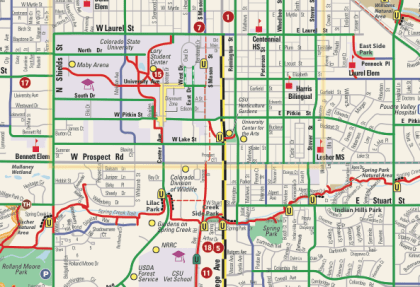
http://www.fcgov.com/bicycling/pdf/bike-map-front.pdf
Filed under: Uncategorized | Tags: air pressure, air resistance, bicycle tech, bicycling, contact patch, cycling, gradient resistance, gravity, mountain biking, optimal air pressure, pedaling resistance, resistance force on a bicycle, rolling resistance, Schwalbe, tire deformation, tire size, tire width, urban cycling
From the Schwalbe tech info pages — http://www.schwalbetires.com/tech_info/rolling_resistance

Filed under: Uncategorized | Tags: Arizona, bicycle, bicycling, bicycling by children, bicycling safety, Bike accidents, child cyclists, curb-cut jungle, industrialized cyclist, kids on bikes, Mesa, pdf, police reports, Safe Routes to School, suburban areas, suburban cycling, suburbia, traffic accidents, transportation, urban cycling
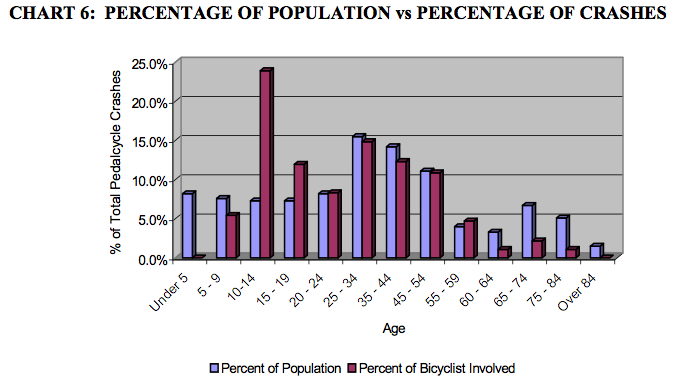
Especially in suburban areas. Here’s Mesa, AZ 2005.
Click to access bike_analysis.pdf
via The Industrialized Cyclist Research Page
click to enlarge
Filed under: Uncategorized | Tags: bicycle, bicycling, bike, biking, cycling, e-bikes, ECF, EU, European Commission, human-powered transportation, motorbikes, motorized transportation, pedelec, urban cycling
Pedelec. A new word to me.
In a vote at the European Parliament today, MEPs have decided to keep the original European Commission proposal; only pedelecs with a maximum speed of 25 km/h and 250 watts power will remain exempt from motorbike regulation. Europe’s cycling organisations have welcomed the move, seeing it as a clear separation between bicycles and motorbikes
Filed under: maps | Tags: baseball mascots, Beverly Hills Cop, bike infrastructure, Detroit, Detroit bicycling, Motor City, pedestrian infrastructure, Rock City, Shia Lebouef, sidewalks, Ted Nugent, the Nuge, urban cycling, urban freestyle walking
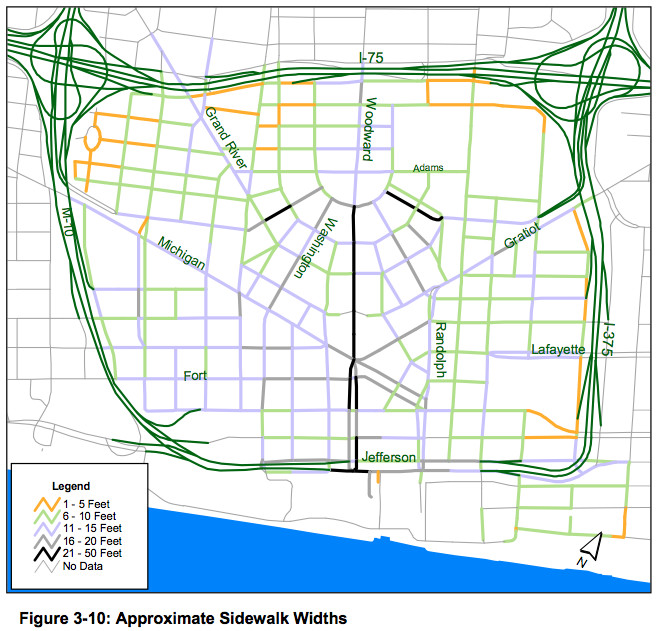
Hey everybody’s got their things, man. Sidewalk width is one of my things.
via Downtown Detroit Master Plan, 2004 (pdf): http://www.detroitmi.gov/Portals/0/docs/planning/planning/transportation/DTMP_2004.pdf
click to enlarge
Filed under: Bike of the Day | Tags: Art of Cycling, art of urban cycling, bicycling, bike, biking, cycling, food, Raleigh, recipe for disaster, transportation, urban cycling, vintage bicycle

Upon closer inspection, looks like a recipe for disaster.
Filed under: Uncategorized | Tags: Chris Christie, gas rationing, gas supplies, gasoline, gasoline shortage, gasoline stocks, petroleum products, refined petroleum, refineries, transportation, urban cycling
The lines themselves only exacerbated the problem; reports in the local media provoked drivers to buy gasoline before stations ran out. Some spent what fuel they had searching for more and could be seen pushing vehicles toward relief.
“I just want to have it, because you don’t know how long this is going to last,” said Richard Bianchi, waiting in the half-mile line at the Sunoco in Union with a tank that was three-quarters full.
via Gasoline Runs Short, Adding Woes to Storm Recovery – NYTimes.com.
This is also what happened after Ike n’ Katrina Gustav in many areas of the South when the refineries went out. (2008 — As described in Cyclist’s Manifesto.) Scarcity of supply does not cause the people to get together, conserve and steward resources. In fact it causes just the opposite reaction. They go nuts, and try to acquire more fuel than they ever did before, faster than they ever did before. Petrol panic! Every man for himself!!
When the going gets tough, the tough do not get going.
Politicians could get pro-active by (1) telling the truth (2) encouraging conservation so those who most need fuel (those who perform critical tasks for the rest of us, for instance) will have it, and (3) instituting a temporary rationing program in advance of supply problems like this, which are easily predicted.
Ha! Can you imagine? No wonder Chris Christie looks like a deer in the headlights.
Filed under: Uncategorized | Tags: art of urban cycling, bike crashes, streetcar tracks, toronto, traffic accidents, transportation, urban cycling
An impressive tally.
However, 96 of the 690 crashes studied in downtown Toronto and Vancouver directly involved streetcar or train tracks. Eighty-seven of those accidents were in Toronto, accounting for 31.5 per cent of all bike accidents in the city that led to an injury that required a visit to an emergency department.
via Streetcar tracks blamed in one-third of Toronto bike accidents.
Filed under: Uncategorized | Tags: bicycle infrastructure, Bike accidents, Canada, cycle tracks, cycling, risk, Teschke, toronto, traffic accidents, transportation, urban cycling
Objectives. We compared cycling injury risks of 14 route types and other route infrastructure features.
Methods. We recruited 690 city residents injured while cycling in Toronto or Vancouver, Canada. A case-crossover design compared route infrastructure at each injury site to that of a randomly selected control site from the same trip.
Results. Of 14 route types, cycle tracks had the lowest risk (adjusted odds ratio [OR] = 0.11; 95% confidence interval [CI] = 0.02, 0.54), about one ninth the risk of the reference: major streets with parked cars and no bike infrastructure. Risks on major streets were lower without parked cars (adjusted OR = 0.63; 95% CI = 0.41, 0.96) and with bike lanes (adjusted OR = 0.54; 95% CI = 0.29, 1.01). Local streets also had lower risks (adjusted OR = 0.51; 95% CI = 0.31, 0.84). Other infrastructure characteristics were associated with increased risks: streetcar or train tracks (adjusted OR = 3.0; 95% CI = 1.8, 5.1), downhill grades (adjusted OR = 2.3; 95% CI = 1.7, 3.1), and construction (adjusted OR = 1.9; 95% CI = 1.3, 2.9).
Conclusions. The lower risks on quiet streets and with bike-specific infrastructure along busy streets support the route-design approach used in many northern European countries. Transportation infrastructure with lower bicycling injury risks merits public health support to reduce injuries and promote cycling. (Am J Public Health. Published online ahead of print October 18, 2012: e1-e8. doi:10.2105/AJPH.2012.300762)
Filed under: Uncategorized | Tags: bicycle, bicycling, Bylenga, cycling, L'Oreal, Pedal Chic, urban cycling
Opened, in 2010.
I’m just saying that making a women-specific store might dissuade George Hincapie from stopping by, which could be a minor tragedy. He buys a lot of spare tubes.
When she was laid off from L’Oréal in 2009 after her division was sold, she decided to take an interim job at a local cycling store.
Within no time, she says, “women began to come in just to talk to me, and to ask questions like what trails were good with kids and what bra I wore when I rode.”
The experience gave her the idea to create a bike-shopping experience for women that, as she says, wasn’t all about how fast you rode or what scars you’d acquired. She imagined a boutique featuring feminine décor, stylish cycling apparel, and positive messages.
In December 2010, after a year of researching the market, Bylenga opened that store, called Pedal Chic, in downtown Greenville, S.C.
via Single mom opens women's bike shop – Oct. 8, 2012.
Filed under: Uncategorized | Tags: bicycling, bike commuting, chain, Chris King, cycle commuting, disk brakes, Dura Ace, headset, S-Works, urban cycling




The Swap is coming up.
Look how disgustingly dirty my chain is.
 Industrialized Cyclist Notepad