


Filed under: Uncategorized | Tags: art of urban cycling, bicycle chains, bicycling, bike maintenance, chain cleaning, cycling, Falcon, Robert Hurst
My non-standard views on chains and cleaning chains, posted recently on the Falcon.com blog:
Rousseau said: Men are born free but everywhere are in chains. A profound observation which foretold the bicycle craze. Then Aretha came along and said: Chain-chain-chain, chain of fools. Which sums it all up quite a bit better in my opinion.
The invention of the chain drive in the 1880s (almost exactly halfway between Rousseau and Aretha) enabled bicyclists to escape the purgatory of the highwheeler era, during which their pedals were shackled directly to those comically large front wheels. Along with Dunlop’s pneumatic tire, Starley’s addition of a chain and gears to the bicycle was certainly one of the most important waypoints in the entire history of personal transportation. The chain drive was a revolution in personal freedom and human dignity.
Not long after the miraculous chain drive took over, however, inventors were thinking of ways to put it out of business. Chains were hardly perfect, after all. They were greasy and needed frequent lubrication, and occasionally tried to take your finger off, realities that diminished the marketing glow of the new form of transportation.
…
Filed under: Uncategorized | Tags: bicycling, biking, cycling, Fort Collins, Idaho stop, Rick Price, stop as yield, urban biking, urban cycling
But I think it’s time we talked about the feasibility of allowing cyclists to treat stop signs as yield signs. This would solve a lot of problems and create some opportunities.
via Price: Do cyclists really need to stop at stop signs? | The Coloradoan | coloradoan.com.
It would probably cause some problems too, but would be an overall positive.
Deliberate signal infractions by bicyclists aren’t nearly as dangerous as people think, or as dangerous as people would like. The evidence is overwhelming.
Right on, Rick.
Filed under: Uncategorized | Tags: bicycling, bike rides, biking around Boulder, biking around Denbver, cycling, Denver and Boulder bicycling, Flagstaff Mountain, Front Range bicycling, road rides Front Range, Robert Hurst
In stores now!!!!!!!! Amazon

Includes almost all the off-road rides in the vicinity and a lot of really cool road rides, mostly on the easy side.
On the cover: coasting down Flagstaff Mountain.
Filed under: Bike of the Day | Tags: apehangers, bicycle, cruiser bike, cycling, Schwinn, urban cycling
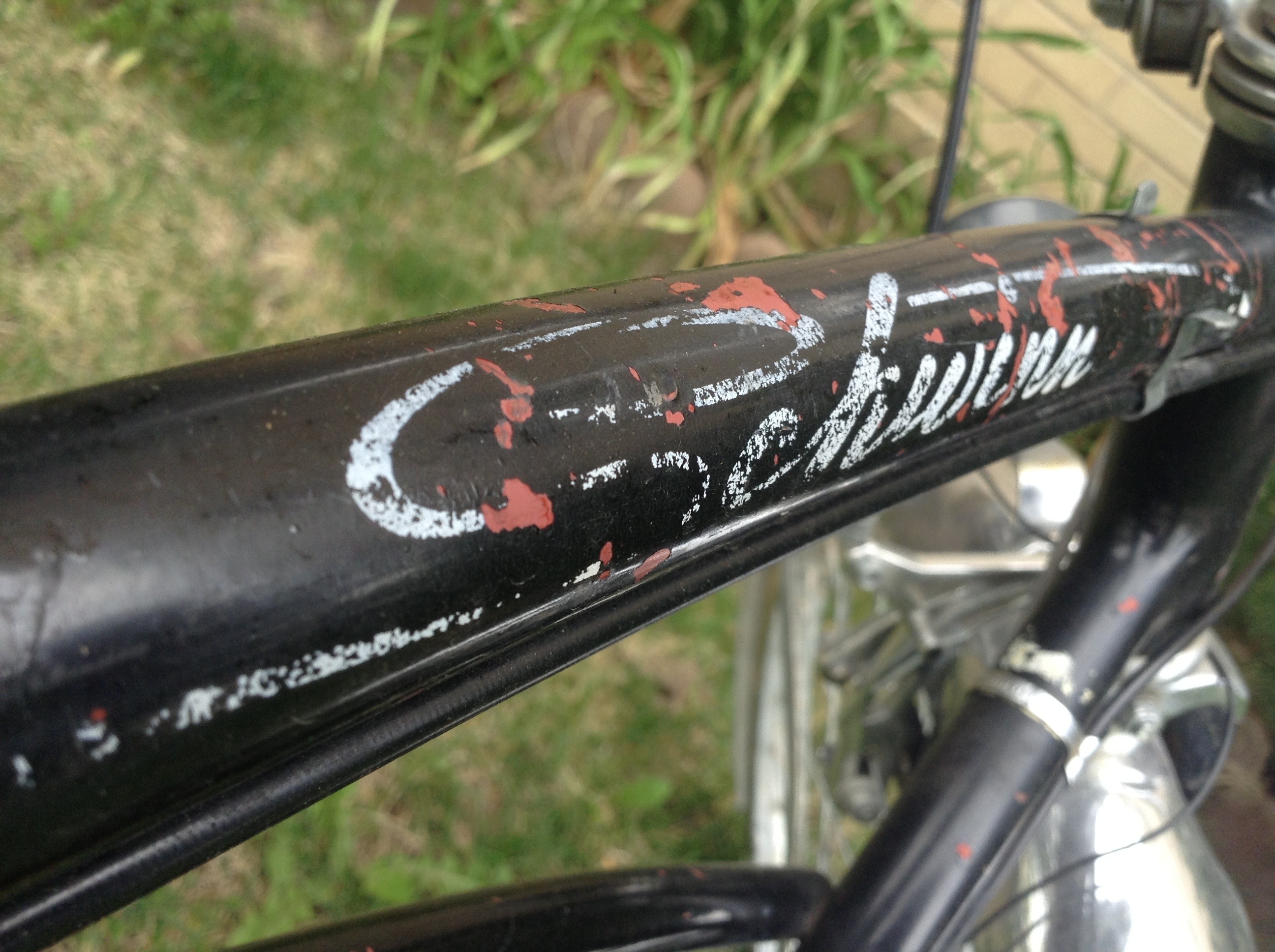

Cruiser style frame, apehanger bars and 10 speeds.
Filed under: Uncategorized | Tags: bicycle helmets, bicycling, Costco Connection, cycling, FalconGuides, helmets, Hurst, Karen Bannan, Robert Hurst, The Bicycle Commuter's Handbook, urban cycling, USCPSC
Big Time Stuff, y’all.
Costco Connection – May 2013 – Page 48-49.
…Some helmets offer more protection, with harder shells and fewer ventilation holes, but will not be as comfortable for long rides, says Robert Hurst, the author of several bicycle-related books, including The Bicycle Commuter’s Handbook (FalconGuides, 2013). “You don’t need to spend a ton of cash to get a decent helmet, but steer clear of bargain-bin knock-offs that haven’t been certified by the U.S. Consumer Product Safety Commission,” he says.
Filed under: Uncategorized | Tags: bicycling, bike-friendly states, cycling, cycling infrastructure, green transportation, LAB, LAW, League of American Bicyclists, League of American Wheelmen, transportation, transportation policy, urban cycling

via League of American Bicyclists (pdf): http://bicyclecolo.org/merchant/117/files/2013BFSrankingchart.pdf
Filed under: Uncategorized | Tags: bicycle helmet laws, bicycle injuries, bicycle safety, bicycling injuries, Bike accidents, bike helmets, child cyclists, children and cycling, cycling, cycling injuries, helmet laws, helmets, mandatory helmet laws, transportation, urban cycling
Pinka Chatterji and Sara Markowitz, “Effects of Bicycle Helmet Laws on Children’s Injuries.” NBER Working Paper No. 18773. February 2013. JEL No. I0,K0
ABSTRACT
Cycling is popular among children, but results in thousands of injuries annually. In recent years, many states and localities have enacted bicycle helmet laws. We examine direct and indirect effects of these laws on injuries. Using hospital-level panel data and triple difference models, we find helmet laws are associated with reductions in bicycle-related head injuries among children. However, laws also are associated with decreases in non-head cycling injuries, as well as increases in head injuries from other wheeled sports. Thus, the observed reduction in bicycle-related head injuries may be due to reductions in bicycle riding induced by the laws.Pinka Chatterji
State University of New York at Albany Economics DepartmentSara Markowitz
Department of Economics Emory University
The auto industry loves mandatory helmet laws.
Filed under: Uncategorized | Tags: bicycle, bicycle safety, bicycling, bike safety, cycling, mandatory helmet laws, Maryland, urban cycling
Would require helmets for adults on bicycles.
Filed under: Uncategorized | Tags: blood bags, cycling, doping, EPO, Vaughters
Tweet from Vaughters:
@Vaughters: @Velo_Vicar So common, that during my time as a rider on a div 1 team, I cannot think of any div1 rider who never doped, outside of Bassons.
That Was Then, This is Now. So clean now. Blood so pure.
Filed under: Uncategorized | Tags: Armstrong, blood bags, blood boosting, blood doping, blood packing, cycling, doping, EPO, Garmin-Cervelo, Garmin-Slipstream, Garmin-weasels, jumping the couch, Lance Armstrong, Lance on Oprah, Millar, peloton lies, transfusions, unmarked motos, Vaughters
And Vaughters, TD, Levi, etc. All very concerned. I would be too. What if LA blows the lid off this “we all decided to quit doping and race clean in 2006” nonsense? Could be trouble in the tangled web.
“My biggest concern is that it will be completely stage-managed, that he will just be ‘given the ball,’ and that it will all be about his emotions rather than concentrating on exactly what he did wrong,” said Millar.
via Millar leery of ‘stage-managed’ Armstrong interview with Winfrey.
When reading about supposed new leafs turned it’s important to keep in mind some things: THE SAME PEOPLE
Filed under: Uncategorized | Tags: bicycle, bicycling, Colorado Springs, cycle touring, cycling, epic climbs, global warming, local warming, Pikes Peak, Pikes Peak Highway, Pikes Peak Toll Road, weird warming
Been to the summit several times on foot and once in an automobile. Can’t wait to ride my bike up that ridiculous road.
7NEWS – Pikes Peak Highway to open to cyclists Jan. 1 – News Story.
But — Jan. 1? The road is open? …. weird…. we are doomed … but sure should be a fun ride… ugh…
Filed under: Uncategorized | Tags: bicycle accident statistics, bicycle accidents, bicycling, car-bike crashes, cycling, cycling injuries, fatality rates, Fatality risk, Great Britain, journal of epidemiology, journal of epidemiology and community health, Mindell, modal risk, OP33, pedestrian accident statistics, pedestrian risk, suburban cycling, transportation, travel modes, urban cycling
Mindell, Lesley, Wardlaw. “Exposure-based Assessment of Modal Travel Risk in England Using Routine Health Data,” Journal of Epidemiology and Community Health, September 13, 2012.
Young male drivers appear to have a higher fatality risk than cyclists in England. This is latched onto as quite good news for cyclists. The results of this study depend entirely on responses given on Britain’s National Travel Survey.
Results: Fatalities per million hours’ use (f/mhu) varied little (0.15–0.45f/mhu by mode for men, 0.09–0.31f/mhu for women). Risks were similar for men aged 21–49 years for all three modes and for female pedestrians and drivers aged 21–69 years. The group most at risk for each mode were: male drivers aged 17–20 years (1.3f/mhu, 95% CI 1.2, 1.4); male cyclists aged 70 years or older (2.2 f/mhu, 1.6, 3.0) and female pedestrians aged 70 years or older (0.95 f/mhu, 0.86, 1.1). In general, fatality rates were substantially higher amongst males than females, except for drivers aged 60 years or older. Risks per hour for male drivers under 30 years were similar or higher than for male cyclists; for 17–20 year olds the risk was higher for drivers (33/Bn km, 95% CI 30, 36; 1.3f/mhu, 1.2, 1.4) than cyclists (20/Bn km, 10, 37; 0.24f/mhu, 0.12, 0.45) using distance or time.
Abstract: http://jech.bmj.com/content/66/Suppl_1/A13.2
Filed under: Uncategorized | Tags: air pressure, air resistance, bicycle tech, bicycling, contact patch, cycling, gradient resistance, gravity, mountain biking, optimal air pressure, pedaling resistance, resistance force on a bicycle, rolling resistance, Schwalbe, tire deformation, tire size, tire width, urban cycling
From the Schwalbe tech info pages — http://www.schwalbetires.com/tech_info/rolling_resistance

Filed under: Uncategorized | Tags: bicycle, bicycling, bike, biking, cycling, e-bikes, ECF, EU, European Commission, human-powered transportation, motorbikes, motorized transportation, pedelec, urban cycling
Pedelec. A new word to me.
In a vote at the European Parliament today, MEPs have decided to keep the original European Commission proposal; only pedelecs with a maximum speed of 25 km/h and 250 watts power will remain exempt from motorbike regulation. Europe’s cycling organisations have welcomed the move, seeing it as a clear separation between bicycles and motorbikes
Filed under: Bike of the Day | Tags: Art of Cycling, art of urban cycling, bicycling, bike, biking, cycling, food, Raleigh, recipe for disaster, transportation, urban cycling, vintage bicycle

Upon closer inspection, looks like a recipe for disaster.
Filed under: Uncategorized | Tags: bicycle infrastructure, Bike accidents, Canada, cycle tracks, cycling, risk, Teschke, toronto, traffic accidents, transportation, urban cycling
Objectives. We compared cycling injury risks of 14 route types and other route infrastructure features.
Methods. We recruited 690 city residents injured while cycling in Toronto or Vancouver, Canada. A case-crossover design compared route infrastructure at each injury site to that of a randomly selected control site from the same trip.
Results. Of 14 route types, cycle tracks had the lowest risk (adjusted odds ratio [OR] = 0.11; 95% confidence interval [CI] = 0.02, 0.54), about one ninth the risk of the reference: major streets with parked cars and no bike infrastructure. Risks on major streets were lower without parked cars (adjusted OR = 0.63; 95% CI = 0.41, 0.96) and with bike lanes (adjusted OR = 0.54; 95% CI = 0.29, 1.01). Local streets also had lower risks (adjusted OR = 0.51; 95% CI = 0.31, 0.84). Other infrastructure characteristics were associated with increased risks: streetcar or train tracks (adjusted OR = 3.0; 95% CI = 1.8, 5.1), downhill grades (adjusted OR = 2.3; 95% CI = 1.7, 3.1), and construction (adjusted OR = 1.9; 95% CI = 1.3, 2.9).
Conclusions. The lower risks on quiet streets and with bike-specific infrastructure along busy streets support the route-design approach used in many northern European countries. Transportation infrastructure with lower bicycling injury risks merits public health support to reduce injuries and promote cycling. (Am J Public Health. Published online ahead of print October 18, 2012: e1-e8. doi:10.2105/AJPH.2012.300762)
Filed under: Uncategorized | Tags: bicycle, bicycling, Bylenga, cycling, L'Oreal, Pedal Chic, urban cycling
Opened, in 2010.
I’m just saying that making a women-specific store might dissuade George Hincapie from stopping by, which could be a minor tragedy. He buys a lot of spare tubes.
When she was laid off from L’Oréal in 2009 after her division was sold, she decided to take an interim job at a local cycling store.
Within no time, she says, “women began to come in just to talk to me, and to ask questions like what trails were good with kids and what bra I wore when I rode.”
The experience gave her the idea to create a bike-shopping experience for women that, as she says, wasn’t all about how fast you rode or what scars you’d acquired. She imagined a boutique featuring feminine décor, stylish cycling apparel, and positive messages.
In December 2010, after a year of researching the market, Bylenga opened that store, called Pedal Chic, in downtown Greenville, S.C.
via Single mom opens women's bike shop – Oct. 8, 2012.
Filed under: Uncategorized | Tags: Alliance for Biking and Walking, bicycle infrastructure, bicycling advocacy, bicycling infrastructure, Bikes Belong, cycling, LAB, lobbyists, urban cycling, wheelmen
Ho hum.
Some months ago there was a lot of talk of three of the major cycling advocacy groups in the United States merging to form a super-group. Now, after months of steady dialogue and face-to-face meetings, the leaders of the Alliance for Biking & Walking, Bikes Belong and League of American Bicyclists have decided not to pursue full unification at this time….
via Proposed merger of three major advocacy groups now unlikely | Bicycle Times Magazine.
Filed under: maps | Tags: 2012 Denver bike map, Bike Denver, bike map, bike maps, bike routes Denver, biking, city bicycling, cycling, denver, Denver bike routes, map, pdf, transportation, urban bicycling, urban cycling
Via Bike Denver. Download: http://www.bikedenver.org/wp-content/uploads/2007/02/Bike_Map_Final_2012_Final.pdf

 Industrialized Cyclist Notepad