


Filed under: maps | Tags: block group level, california, census block, Chinatown, climate, electricity consumption, energy, energy consumption, energy use, kilowatt hours, Los Angeles, sustainable communities, unsustainable communities, urban
Here: http://sustainablecommunities.environment.ucla.edu/map/

This map displays average monthly energy consumption in kilowatt hours (kWh) at the Census block group level between January 2011 and June 2012.
Goes nicely with the NYC report “NYC Energy Benchmarking Report for Non-Residential Properties”.
Filed under: Uncategorized | Tags: electricity, energy, Paul Dastoor, renewable energy, solar, solar cells, solar energy
Professor Paul Dastoor and his team have been working to create solar cells that can be printed directly onto surfaces like metal sheets, and they are aiming to eventually develop solar cells that can simply be painted directly onto surfaces.
via Solar Tribune: Australian team developing low-cost solar paint – Solar Tribune.
Filed under: Uncategorized | Tags: bailout, Brussels, CH4, Cyprus, ECB, energy, EU, euro, Gazprom, Israel, Lebanon, Levant, Levant Basin, Leviathan, Natural gas, Russia, Syria
Cyprus has known from the beginning that its bailout is tied to its potential petrol dollars, while the EU has attempted to couch this in all manner of moral-high-ground rhetoric.
What will the EU do now? Will it bail Cyprus out on kinder terms to keep Russia from getting hold of the island’s gas? Monday is D-Day: This is the deadline the European Central Bank has set for Cyprus to come up with $6 billion in order to “qualify” for a bailout package.
Cyprus is playing Russia and the EU offer each other right now, hoping to bring the specter of a deal with Russia close enough to make Brussels blink and give Cyprus more negotiating power.
Watch the deals in progress with this in mind: Not only is Cyprus’ financial collapse at stake here. Also at stake is Russia’s monopoly on the European gas market and the Europe’s entire gas future.
via Oilprice.com: EU Caught Playing Dirty and it’s all about Russian Gas.
Filed under: Uncategorized | Tags: CH4, China, Chindia, CO2, coal, electricity, energy, India, Peak Smart, power plants
Forgetting to start our renewable energy project.
Global demand for coal is expected to grow to 8.9 billion tons by 2016 from 7.9 billion tons this year. China is expected to add about 160 new coal-fired plants to the 620 operating now, within four years. During that period, India will add more than 46 plants.
Oh well.
Filed under: Uncategorized | Tags: Alice Cooper, API, Eighteen, energy, oil demand, peak oil, petroleum demand, US oil consumption
18-year low oil demand. 18 million barrels per day.
18 and I like it.
U.S. Oil Demand Fell to 18-Year Low for January, API Says – Bloomberg.

Filed under: maps, Uncategorized | Tags: crude oil supply, Cushing, EIA, energy, oil pipelines, oil transportation, petroleum products, pipeline map, refineries, US oil production, WTI

Via EIA:
This Week In Petroleum Summary Printer-Friendly Version.
Filed under: Uncategorized | Tags: cost of extraction, energy, Kurt Cobb, Natural gas, oil production, peak oil
Here and there on occasion. Kurt Cobb in the CSM:
Currently, there appears to be no new transformative on-the-shelf technology that will significantly reduce the cost of extracting oil and natural gas. And so, barring a deep economic depression, we can look forward to prices for oil and natural gas that are consistently above the cost of production and therefore far above the bizarrely low forecasts in the air today. In fact, we should expect costs to continue to escalate as we seek out resources that are ever more difficult to extract and refine.
via Natural gas, oil prices: why the long-term forecasts are wrong – CSMonitor.com.
Filed under: Uncategorized | Tags: 2013 oil price, Brent, crack spread, crude oil, EIA, energy, gas prices, oil price predictions, refinery profits, transportation, WTI
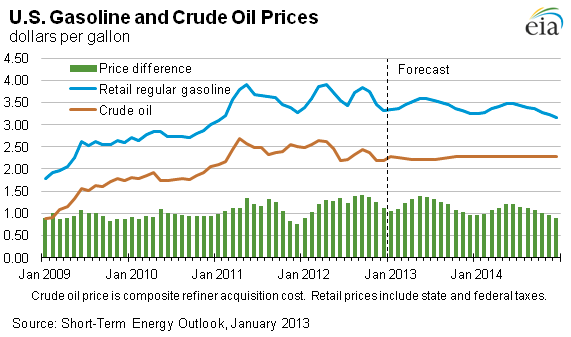
Always kind of funny. Flat-line forever.
Filed under: Uncategorized | Tags: Alaska, Beaufort Sea, Coast Guard, energy, Kulluk, oil production, peak oil, Royal Dutch Shell, Shell
‘Season full of headaches:’
Adding to a season full of headaches for Shell Alaska’s debut offshore-drilling program in the U.S. Arctic, the company’s Kulluk drill rig was stuck Friday in monster seas off the coast of Alaska as its tugboat’s engines failed and the Coast Guard cutter that came to assist became entangled in a towline.
There were no immediate threats to crew or equipment, but Shell Alaska was rushing additional aid vessels to the scene as the Kulluk, which drilled the beginnings of an exploratory oil well in the Beaufort Sea over the summer, sat without ability to move forward in 20-foot seas about 50 miles south of Kodiak.
via Coast Guard cutter hits trouble trying to aid Shell rig off Alaska | Local News | The Seattle Times.
Don’t freak out, but this is what Peak Oil For All Intents And Purposes looks like.
Filed under: maps | Tags: brine, climate, diagonal drilling, energy, environment, fracking, fracking waste, gaming, HCLs, horizontal drilling, Marcellus Shale, natural gas production, radioactive fracking waste, vertical drilling
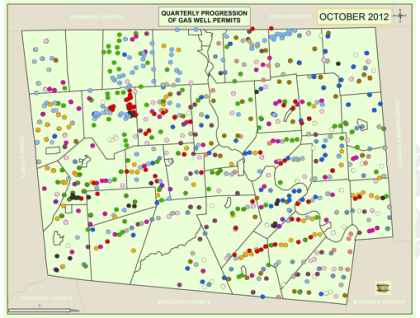
A link to an animated map of drilling operations in Bradford County since 2008.
http://www.bradfordcountypa.org/Natural-Gas.asp?specifTab=2
Filed under: Uncategorized | Tags: Alberta, Canada, China, ECA, Encana, energy, energy security, PetroChina
PetroChina Co. (857) agreed to pay Encana Corp. (ECA) C$1.18 billion ($1.2 billion) for a 49.9 percent stake in an Alberta shale formation as Asia’s biggest oil producer steps up acquisitions of overseas oil and gas assets.
via PetroChina Pays $1.2 Billion to Form Encana Joint Venture – Bloomberg.
Filed under: Uncategorized | Tags: 2012, 2019, AEO table browser, EIA, energy, Hubbert, oil predictions, oil production, peak oil, U.S. crude oil production
7.54 mbd of crude in 2019. According to the EIA’s “AEO Table Browser:”
AEO Table Browser – Energy Information Administration.
See also: THE AMAZING RED MOUND, BAKKEN DEVELOPMENT BY COUNTY, EPA FRACKING AIR POLLUTION RULES, MONTANA CRUDE OIL PRODUCTION, LIVESTOCK IN FRACKING REGIONS
Filed under: Uncategorized | Tags: biology, China, Chinese energy production, energy, energy production, fracking, oil production, peak oil, water, water pollution
Everyone knows that oil and gas are more important than water. Right?
If fracking takes off in China as planned, it will likely exacerbate the nation’s existing water crisis. “Most of the nation’s shale gas lies in areas plagued by water shortages,” the report says. With about 20 percent of the world’s population and only 6 percent of the world’s water resources, China is one of the least water-secure countries in the world. Its water shortages are made worse by pollution: According to the Ministry of Water Resources about 40 percent of China’s rivers were so polluted they were deemed unfit for drinking, while about 300 million rural residents lack access to safe drinking water each year.
via China planning 'huge fracking industry' | Environment | guardian.co.uk.
Filed under: Uncategorized | Tags: Afghanistan, afghanistan pakistan, energy, India, India oil imports, Iran, Natural gas, natural gas exports, natural gas imports, Pakistan, TAPI, Trans-Caspian pipeline, transportation, Turkmen gas pipeline, Turkmenistan
Turkmenistan-Afghanistan-Pakistan-India

via Investors sought for for Turkmen gas pipeline – The National.
Filed under: maps, Uncategorized | Tags: Arafat, British Gas, Cast Lead, Egypt, energy, energy exploration, gas reserves, Gaza, Gaza Strip, Israel, Israeli invasion, Koury, Levantine Corridor, Natural gas, offshore gas production, oil and gas, Palestine, Palestinian Authority, Polonium, polonium Francois Bochud, Sabbagh, TIP line

click to sharpen
British Gas (BG Group) and its partner, the Athens based Consolidated Contractors International Company (CCC) owned by Lebanon’s Sabbagh and Koury families, were granted oil and gas exploration rights in a 25 year agreement signed in November 1999 with the Palestinian Authority.
Filed under: Uncategorized | Tags: available net exports, energy, JODI, Joint Oil Data Initiative, KSA, oil demand, peak oil, Saudi Arabia, Saudi Arabian oil consumption, Saudi Arabian oil production, Taco Bell
Leaving less for our late-night Taco Bell runs.
DUBAI, Nov 19 (Reuters) – Saudi Arabia burned record volumes
of crude oil over the summer, official government figures show,
contrary to its aim of using more gas for power generatation to
reduce wastage of crude that it could export.
During the peak period from early June through September,
Saudi Arabia burned an average of 763,250 barrels per day (bpd)
of crude, compared to an average of 701,250 bpd last year and
747,750 bpd in the previous record summer of 2010, official
government data issued on Sunday under the Joint Oil Data
Initiative (JODI) shows.
via Saudi summer oil burning hits record high in 2012 -JODI – Yahoo! News.
Filed under: Uncategorized | Tags: Bakken, crude oil, demand destruction, energy, fracking, IEA, KSA, mbd, oil consumption, oil production, Our Finite World, refinery gain, Saudi Arabia, Saudi Arabian oil production, shale gas, shale oil, tight gas, tight oil, Tvberg, Tverberg, unconventional oil, US oil production, WEO, World Energy Outlook
The happy talk on future production is crazier than ever in the latest IEA World Energy Outlook, but there are also some stunningly pessimistic predictions buried inside. Wild!
For instance: The US will become number one oil producuh again and rediscover our lost oil-producing prowess with about 11 million barrels/day (Yay!) — which must mean Saudi Arabia won’t approach IEA’s previous prediction for that country of roughly 15 mbd output (Ooof). And the predicted exporter status of the US (Yay!) relies as much on a huge drop in consumption as it does on increases in production (Ooof). So it’s a bit of a sad day in IEA land, where consumption always went up, up, up.
From Tverberg:
The International Energy Agency (IEA) provides unrealistically high oil forecasts in its new 2012 World Energy Outlook (WEO). It claims, among other things, that the United States will become the world’s largest oil producer by 2020, and will become a net oil exporter by 2030.

Figure 1. Author’s interpretation of IEA Forecast of Future US Oil Production under “New Policies” Scenario, based on information provided in IEA’s 2012 World Energy Outlook.
Figure 1 shows that this increase comes solely from the expected rise in tight oil production and natural gas liquids. The idea that we will become an exporter in later years occurs despite falling production, because “demand” will drop so much.
Note that IEA and other maniacs add NGLs, biodiesel and even ‘refinery gain’ to the US oil production number, in a crude attempt to fool y’all.
Filed under: Uncategorized | Tags: China, energy, fracking, good cop-bad cop, jobs, LNG, LNG exports, LNG trade, Natural gas, natural gas trade movements, Obomney, OMG, RBAC, Robama, shale gas, tight gas, trade deficit
“We are confident that either one would be supportive of LNG exports,” Cooper told Rigzone.
U.S. LNG imports, which peaked at nearly 2.4 billion cubic feet per day in 2007, have fallen substantially as the growth in North American gas production due to shale gas, according to an Oct. 18 report by RBAC Inc., a company that develops and licenses management decision support systems for the energy industry. As a result, LNG facility backers are now seeking to outfit existing U.S. LNG import facilities with liquefaction equipment to ship LNG overseas.
Proponents say U.S. LNG exports will benefit the United States by creating construction jobs, and generate revenue to reduce the U.S. trade deficit through LNG sales and federal, state and local government tax revenues.
via RIGZONE – Romney, Obama Seen Favoring U.S. LNG Exports.
Know what else creates jobs and generates revenues? Cheap domestic gas. Exporting gas which would otherwise be flooding the U.S. market would raise the price for Americans. This would probably destroy a lot more jobs than would be created to build and maintain LNG terminals. The job-creation argument goes out the window.
In the meantime, the negative consequences of energy production would accrue right here in America.
Are western Americans willing to sacrifice their water so international companies can frack their shale gas and ship it to China? Robomney bets yes.
Filed under: Uncategorized | Tags: emergency generators, energy, Hurricane Sandy, nuclear accidents, nuclear plant, nuclear power, Oyster Creek, radiation dump, radiation leak, Salem
While worriers worried about Oyster Creek, several plants in the path of the storm experienced “events.” Salem: atmospheric steam dump…
NRC: Current Event Notification Report for October 30, 2012
MANUAL REACTOR TRIP FROM 100% POWER
“This report if being made under the requirements of 10 CFR 50.72(b)(2)(iv)(B), Actuation of the Reactor Protection System While Critical, except preplanned, and under the requirements of 10 CFR 50.72(b)(3)(iv)(A), Valid Actuation of Listed System, except preplanned.
“Salem Unit 1 was operating at 100% reactor power when a loss of 4 condenser circulators required a manual reactor trip in accordance with station procedures. The cause of the 4 circulators being removed from service was due to a combination of high river level and detritus from Hurricane Sandy’s transit.
“All control rods inserted. A subsequent loss of the 2 remaining circulators required transition of decay heat removal from condenser steam dumps to the 11-14 MS10s (atmospheric steam dump). Decay heat removal is from the 11/12 Aux Feed Pumps to all 4 steam generators via the 11-14 MS10s. 11/12/13 AFW pumps started due to low level on all steam generators due to shrink from full power operation (this is a normal response). All safety related equipment functioned as expected. No one has been injured. As an additional note, Hurricane Sandy had recently moved past artificial island. Salem Unit 1 is currently in Mode 3. Salem Unit 2 reactor is currently in its 2R19 refueling outage and is shutdown and defueled with no fuel movement in progress.”
via NRC: Current Event Notification Report for October 30, 2012.
Filed under: Uncategorized | Tags: energy, freshwater, gallons per day, irrigation, power, self-supplied, tap water, USGS, water use, water withdrawals
via (pdf) : http://iopscience.iop.org/1748-9326/7/3/034034/pdf/1748-9326_7_3_034034.pdf
Just an aside in a very interesting paper, “Evaluating the Energy Consumed for Water Use in the United States.”
“Self-Supplied” means they sucked it right out of a river, lake or aquifer.

click to enlarge
 Industrialized Cyclist Notepad