


Filed under: Uncategorized | Tags: horizontal drilling, peak oil, Stanzione, the death of journalism, vertical drilling
It’s the next big thing!
It’s not just a U.S. story as well as a U.S. boom. Stanzione identifies Iraq, Canada and Brazil as all having great advantages from new oil discoveries and more effective drilling techniques such as vertical drilling.
“It’s not just a U.S. story as well as a U.S. boom… vertical drilling…” Maybe the Sacramento Bee is using Wackenhut editors.
Filed under: Uncategorized | Tags: energy, peak oil, transportation, urban cycling, vehicle miles traveled, Vmt
Interesting times, exhibit 67.
Via http://www.fhwa.dot.gov/policyinformation/travel_monitoring/12jultvt/index.cfm

Filed under: Uncategorized | Tags: China, Chinese coal production, climate, CO2 production, coal, EIA, energy, global coal production, global warming, peak oil
The rise in global production over the past decade is almost entirely due to Chinese production…
via the EIA via http://www.theoildrum.com/node/9485

Filed under: Uncategorized | Tags: BP, deepwater drilling, energy, GOM, holding station, Hurricane Isaac, jackups, oil production, oil supply, peak oil, platforms, rigs, shut in, Transocean, US oil production
Updated August 30. Almost all of Gulf shut down.
Based on data from offshore operator reports submitted as of 11:30 a.m. CDT today, personnel have been evacuated from a total of 509 production platforms, equivalent to 85.4 percent of the 596 manned platforms in the Gulf of Mexico. Production platforms are the structures located offshore from which oil and natural gas are produced. Unlike drilling rigs, which typically move from location to location, production facilities remain in the same location throughout a project’s duration.
Personnel have been evacuated from 50 rigs, equivalent to 65.79 percent of the 76 rigs currently operating in the Gulf. Rigs can include several types of self-contained offshore drilling facilities including jackup rigs, submersibles and semisubmersibles.
via BSEE Hurricane Isaac Activity Statistics: August 30, 2012 | BSEE.
Filed under: Uncategorized | Tags: Chinese oil demand, oil demand, peak oil, petroleum demand, Robert Rapier
Continued to rise even as prices doubled, tripled…Explained in a nice little article by Rapier..
The 20th barrel the average person in the U.S. consumes each year might allow us to drive that 12,000th mile. But the first barrel that someone in a developing country consumes might allow them to drive that very first mile and have heat in their home for the first time. They will be willing to pay a lot more for those initial barrels than we are for our excess barrels, and this explains why their consumption has increased even as oil prices have risen.
http://www.theoildrum.com/node/9386#more

click to enlarge
Filed under: Uncategorized | Tags: DOT, energy, extrapolations, government estimates, peak oil, s, transportation, vehicle miles traveled
I have no idea. Just throwing that out there as a question.
I do know that quantifying the total amount of driving that has occurred on “all roads” by an entire population is necessarily a dark art, prone to wild extrapolations.

Currently not falling off a cliff, according to DOT.
via (pdf) http://www.fhwa.dot.gov/policyinformation/travel_monitoring/12maytvt/12maytvt.pdf
Filed under: Uncategorized | Tags: crude oil, demand growth, demand plateau, energy, OECD, oil consumption, oil demand, oil demand forecast, OPEC, Peak Demand, peak oil
Interesting times.
“Demand in the OECD is in structural decline and we’re not expecting that to change,” he said, adding that the IEA’s forecasts do take into account recent weaker economic activity in the Asia-Pacific region.
According to the report, which contains the IEA’s first forecasts for 2013, global oil demand will be 1.1% higher than 2012, averaging 90.9 million barrels a day.
The forecasts are more bullish than reports earlier this week from the U.S. Energy Information Administration and the Organization of Petroleum Exporting Countries, both of whom projected slower global oil demand growth in 2013 of 730,000 barrels a day and 800,000 barrels a day respectively.
via RIGZONE – IEA: 2013 Oil Demand Growth Higher On Muted Recovery.
Filed under: Uncategorized | Tags: American oil production, crude oil, crude oil production, Econbrowser, energy, James Hamilton, oil production, peak oil, Texas oil production, Texas Railroad Commission, tight oil, transportation, westtexas
A historical perspective.

via Econbrowser and James Hamilton: http://www.econbrowser.com/archives/2012/07/shale_oil_and_t.html
Filed under: Uncategorized | Tags: Bakken, Bakken Shale, crude oil, energy, horizontal drilling, James Hamilton, Jeffrey Brown, marginal costs of production, natural gas liquids, Niobrara, oil price, oil shale, peak oil, shale oil, shale plays, tight gas, tight oil, tight oil formations, unconventional oil, westtexas
Throwing a little cold water on some recent, loudly reported unscientific predictions. When you read Hamilton, always be sure to read the comments by Jeffrey Brown for an important Big Picture view.
In addition to the uncertainties noted above about extrapolating historical production rates, the rate at which production declines from a given well over time is another big unknown. Another key point to recognize is the added cost of extracting oil from tight formations. West Texas Intermediate is currently around $85/barrel. With the huge discount for Canadian and north-central U.S. producers, that means that producers of North Dakota sweet are only offered $61 a barrel. Tight oil is not going to be the reason that we return to an era of cheap oil, for the simple reason that if oil again fell below $50/barrel, it wouldn’t be profitable to produce with these methods. Nor is tight oil likely to get the U.S. back to the levels of field production that we saw in 1970. But tight oil will likely provide a source of significant new production over the next decade as long as the price does not fall too much.
via Econbrowser: Shale oil and tight oil.
Filed under: Uncategorized | Tags: construction, construction employment, employment, housing, housing bottom, jobs numbers, peak oil, suburban development, unemployment, urban, zero hedge
…skittering along down there…

click to enlarge
via http://www.zerohedge.com/news/point-out-housing-bottom-chart
Filed under: Uncategorized | Tags: April 2012, bicycling, cars, DOT, peak oil, transportation, urban cycling, USDOT, vehicle miles traveled, Vmt
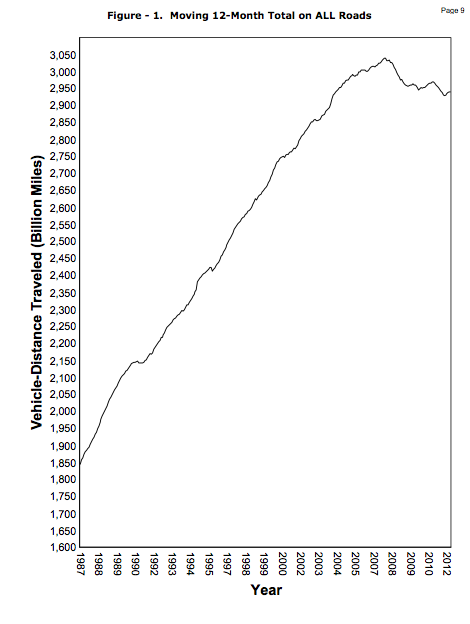
The latest govt. numbers. April ’12 down a little over April ’11. 53 months and counting.
Filed under: Uncategorized | Tags: cargo, diesel, energy, peak oil, transportation, trucking
Filed under: Uncategorized | Tags: 30 8-K, air travel BP, Anderson, Delta Airlines, energy, jet fuel, peak oil, Trainer refinery, transportation
Yeah, I don’t think so.
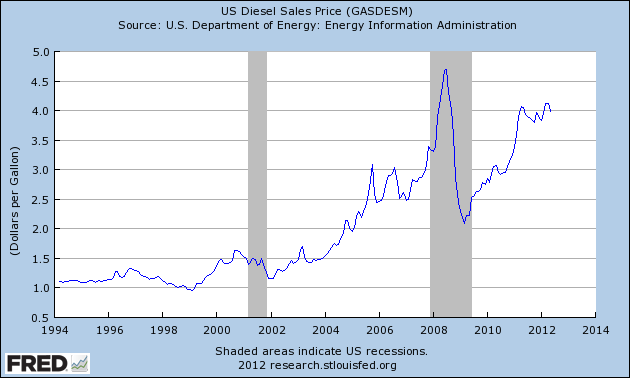
“We’re probably the largest private purchaser of jet fuel in the United States but we don’t get to participate in the pricing function,” Anderson told reporters after the Delta’s annual meeting in New York. “It’s our intention to begin to participate in the pricing function and put a lot of downward pressure on the cost of refining a barrel of jet fuel.”
The Trainer refinery will produce 52,000 barrels a day of jet fuel, according to slides published in an April 30 8-K filing by the company. Delta will exchange all other products with BP Plc (BP/) and Phillips 66 (PSX) for an additional 120,000 barrels a day of jet fuel in other locations around the country. The airline consumes about 210,000 barrels a day in the U.S.
via Delta CEO Says Airline to Pressure Prices as Jet Fuel Seller – Bloomberg.
Filed under: maps | Tags: Arab Emirates, crude oil, crude pipeline, Emirates, energy, global crude oil, Habshan-Fujairah, Iran, middle-east, oil production, oil transport, peak oil, Persian Gulf, pipeline, Strait of Hormuz, UAE
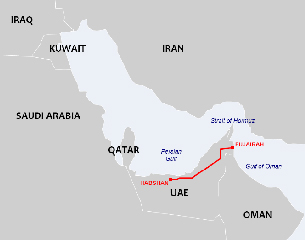
Will help a little bit with the whole Strait of Hormuz thing.
Filed under: Uncategorized | Tags: driving in the United States, federal gas tax, gas taxes, peak oil, road maintenance, road repair, transportation, urban cycling, Vmt, VMT tax
A tax based on miles driven. This also seems to imply GPS tracking of individual vehicles. Politicians can’t even propose an increase in the gas tax which is unreasonably low. So don’t hold your breath on a VMT tax with privacy issues.
The efforts are being prompted by the fact that gasoline taxes no longer provide enough money to pay for roads and bridges — especially when Congress and many state legislatures are reluctant to increase taxes imposed on each gallon. The federal tax of 18.4 cents a gallon hasn’t been raised in nearly two decades. More than half the states have not raised their gas tax this millennium. Fuel-efficiency also is behind the efforts. Electric-powered vehicles are growing in numbers.
We can hear about gains in ‘efficiency’ because that’s something the politicians want to take credit for.
What the politicians/media studiously ignore, for reasons I’ll leave you to ponder: VMT (vehicle miles traveled) has been below its previous peak for about 4 years, after climbing almost uninterrupted for a half century or more, which is remarkable. People are driving less. Probably this has a great deal to do with the increase in people sitting on their couches instead of going to jobs; the demography of our aging population; and the cultural shift away from teen driving; as well as the price of fuel.
via States explore new ways to tax motorists for road repair – USATODAY.com.
Filed under: Uncategorized | Tags: crude oil production, energy, Forbes, global oil productionoil production statistics, JODI, KSA, OECD, oil production, OPEC, peak oil, production numbers, Russia, Russian energy ministry, russian oil, Russian oil production, Saudi Arabia, Saudi Arabian oil production
…between official Russian oil production numbers and JODI numbers.
via http://www.forbes.com/sites/markadomanis/2012/05/20/is-russian-oil-production-plummeting/

Filed under: Uncategorized | Tags: budget deficit, budget surplus, energy, Finland, GDP, Norway, peak oil, socialism, Sweden
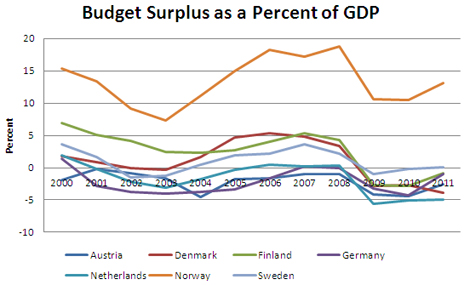
Not compared to N. American ‘capitalism.’ Despite the onslaught of talking heads and columnists sent to convince you otherwise. Many of you will find the reality of the situation very disappointing, but it is what it is.
Via Beat the Press: http://www.cepr.net/index.php/blogs/beat-the-press/david-brooks-self-doubt-and-self-confidence
Filed under: Uncategorized | Tags: Alberta tar sands, Canada, energy, ezra levant, foreign control of tar sands, oil sands, peak oil, tar sands, unconventional oil, Yergin
http://www.desmogblog.com/tar-sands-oil-companies-71-percent-foreign-owned-cue-ezra-levant-s-outrage

In a recent Bloomberg interview, Dan Yergin suggested we consider Canada as “not a foreign country,” thus oil from Canada is just like oil produced within the United States. Voila! Turns out oil from Canada is not even like oil from Canada.
Filed under: Uncategorized | Tags: ASPO, crude oil production, EIA, energy, Jeffrey Brown, oil production propaganda, peak oil, production numbers, Railroad Commission of Texas, RRC, Texas, Texas crude oil production, transportation
According to the Railroad Commission of Texas.
http://www.rrc.state.tx.us/data/production/oilwellcounts.php
Some individuals recently noting the difference between RRC and EIA production numbers. From a comment by Jeffrey Brown:
Total US Crude Oil Production (EIA, mbpd):
2002: 5.746
2003: 5.681
2004: 5.419
2005: 5.178
2006: 5.102
2007: 5.064
2008: 4.950
2009: 5.361
2010: 5.476
2011: 5.662Total US Crude Oil Production, using RRC data for Texas, instead of EIA (Gap Between the two data sets):
2002: 5.615 (+131,000 bpd)
2003: 5.548 (+133,000)
2004: 5.303 (+116,000)
2005: 5.059 (+119,000)
2006: 4.948 (+154,000)
2007: 4.898 (+166,000)
2008: 4.813 (+137,000)
2009: 5.199 (+162,000)
2010: 5.285 (+194,000)
2011: 5.324 (+338,000)
http://www.theoildrum.com/node/9191#comment-893345
 Industrialized Cyclist Notepad