


Filed under: Uncategorized | Tags: ANE, China, China oil consumption, China oil imports, Chindia, crude oil, peak oil, The Yergin Gap, westtexas, Yergin
“China is importing an increasing amount of crude, which is the most crucial issue for the country’s energy supply,” said Zhang during the Boao Forum for Asia Annual Conference
And the most crucial issue for the world’s energy supply too.
One way to look at it is that we in the west are being outbid by people in Asia for available oil exports. The price is high because if it were any lower people would want to consume more than can currently be produced.
via China depends more on overseas oil |Economy |chinadaily.com.cn.
Filed under: Uncategorized | Tags: cesium, congenital hypothyroidism, fallout, Fukushima, hypothyroidism, I-131, infant mortality, iodine, meltdowns, nuclear accident, nuclear weapons tests, pediatrics, thyroid
http://www.scirp.org/journal/PaperInformation.aspx?PaperID=28599
Mangano and Sherman, “Elevated airborne beta levels in Pacific/West Coast US States and trends in hypothyroidism among newborns after the Fukushima nuclear meltdown” Open Journal of Pediatrics, Volume 3, Number 1, March 2013.
1.2. Exposure to Radioactive Iodine as a Factor
in Congenital HypothyroidismAnother potential environmental risk factor is prenatal
exposure to radioactive iodine isotopes, which seek out
the susceptible fetal thyroid gland. For decades radioactive
iodine has been recognized to cause adverse effects
(including hypothyroidism) to the thyroid gland. The
fetal thyroid, the first glandular structure to appear in the
human embryo [14], begins to concentrate iodine and
produce thyroid hormones by the 70th day of gestation
[15]. In the mid-1950s, during the period of atmospheric
nuclear weapons tests, I-131 produced by fission was
first detected in the adult human thyroid [16,17]. I-131
concentrations were calculated to be about 10 times
higher in the human fetal thyroid vs. the human adult or
hog thyroid [18], and maximum elevations in fetal thy-
roids were detected approximately one month after nuclear
explosions [19]. The main path of exposure to shortlived
isotopes such as I-131 is via dairy products due to
radioactive fallout deposition on forage [20].[…]
It gets all over the grass, the cows eat the grass, and the I-131 and Cesium are thus concentrated in cheese and milk.
…Large amounts of fallout disseminated worldwide from the meltdowns in four reactors at the Fukushima-Dai-ichi plant in Japan beginning March 11, 2011 included radioiodine isotopes. Just days after the meltdowns, I-131 concentrations in US precipitation was measured up to 211 times above normal. Highest levels of I-131 and airborne gross beta were documented in the five US States on the Pacific Ocean. The number of congenital hypothyroid cases in these five states from March 17-December 31, 2011 was 16% greater than for the same period in 2010, compared to a 3% decline in 36 other US States (p < 0.03). The greatest divergence in these two groups (+28%) occurred in the period March 17-June 30 (p < 0.04). …
Filed under: Uncategorized | Tags: Alberta, bitumen, dilbit, diluted bitumen, Exxon, heavy oil, Keystone XL, Mayflower, oil, oil transportation, pegasus, pipeline rupture, tar sands, unconventional oil
I’m sure you’ll be able to sell your house, no problem..
Many photos of Exxon’s Mayflower, Arkansas spill (definitely not oil) via EPA On-site Coordinator website: http://epaosc.org/site/image_list.aspx?site_id=8502

Filed under: Uncategorized | Tags: abaya, America's Gas Station, bicycle ban, bicycle smile, bicycling, cycling ban, desert cycling, KSA, MIA, Saudi Arabia, Saudi Arabian oil consumption, this is largely our fault
The kingdom’s religious police are now allowing women to ride bikes in parks and recreational areas.
However, they have to be accompanied by a male relative and dressed in the full Islamic head-to-toe abaya.
via Saudi Arabia lifts ban on women riding motorbikes and bicycles | Mail Online.
No cycling for transportation of course. Not in the Big Gas Station. A strange policy considering that every time somebody gets into a car in SA, it comes straight out of the profits of the princes.
I guess the Saudi religious police have never heard of ‘bicycle smile.’
Filed under: Uncategorized | Tags: does this make sense, FHWA, say huh, vehicle miles traveled, Vmt, x axis
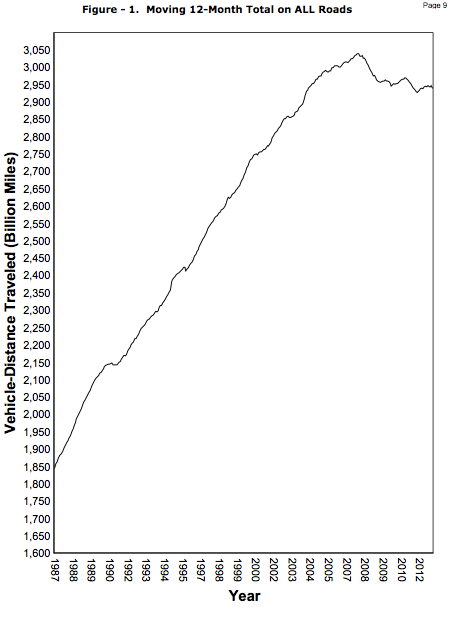
Notice anything weird about this VMT chart (other than its unusual downward trend that is)? I never noticed it before..
via http://www.fhwa.dot.gov/policyinformation/travel_monitoring/13jantvt/index.cfm

[Mexico vs. USA en vivo ahora..]
Filed under: Uncategorized | Tags: california, car culture, FHA, Gloria, Hecox, mode share, National Household Travel Survey, patterns of use, San Diego, transportation, trip distance, vehicle trips, Vmt, Voice of San Diego
Saw this first at http://www.cyclelicio.us
The new definition of 40%.
The 2009 study [National Household Travel Survey] showed 40 percent of trips recorded by more than 300,000 participants were two miles or less.
The statistic incorporated all forms of transportation — cars, bicycles, subways and more, said Doug Hecox, a spokesman for the Federal Highway Administration.
[…]
If one simply focuses on car trips, the percentage of short trips increases significantly.
According to the research, 69.1 percent of trips were two miles or less, Hecox said.
via Driving When You Could Bike: Fact Check – Voice of San Diego: San Diego Fact Check.
Filed under: Uncategorized | Tags: electricity, energy, Paul Dastoor, renewable energy, solar, solar cells, solar energy
Professor Paul Dastoor and his team have been working to create solar cells that can be printed directly onto surfaces like metal sheets, and they are aiming to eventually develop solar cells that can simply be painted directly onto surfaces.
via Solar Tribune: Australian team developing low-cost solar paint – Solar Tribune.
Filed under: Uncategorized | Tags: carbon dioxide emissions, China, Chindia, climate, CO2, Econbrowser, James Hamilton, natural gas liquids, NGLs, oil consumption, Peak Demand, peak oil, total liquids, transportation

And it’s worth remembering why that happened– we didn’t have a choice. Global field production of crude oil (excluding natural gas liquids, which are not used as transportation fuel) stagnated at about 74 million barrels/day between 2005 and 2008. It is up a couple of million barrels since then, but more than 100% of this increase has been consumed by China alone, forcing the U.S. and other countries to reduce our oil consumption.
via James Hamilton: Econbrowser: Declining U.S. carbon dioxide emissions.
Filed under: Uncategorized | Tags: bailout, Brussels, CH4, Cyprus, ECB, energy, EU, euro, Gazprom, Israel, Lebanon, Levant, Levant Basin, Leviathan, Natural gas, Russia, Syria
Cyprus has known from the beginning that its bailout is tied to its potential petrol dollars, while the EU has attempted to couch this in all manner of moral-high-ground rhetoric.
What will the EU do now? Will it bail Cyprus out on kinder terms to keep Russia from getting hold of the island’s gas? Monday is D-Day: This is the deadline the European Central Bank has set for Cyprus to come up with $6 billion in order to “qualify” for a bailout package.
Cyprus is playing Russia and the EU offer each other right now, hoping to bring the specter of a deal with Russia close enough to make Brussels blink and give Cyprus more negotiating power.
Watch the deals in progress with this in mind: Not only is Cyprus’ financial collapse at stake here. Also at stake is Russia’s monopoly on the European gas market and the Europe’s entire gas future.
via Oilprice.com: EU Caught Playing Dirty and it’s all about Russian Gas.
Filed under: Uncategorized | Tags: 1%, 100%, 99%, advertising, fake recycling, fakery, greenwashing, marketing, paper towels, recycled paper, recycling, safeway, snake oil salesmen, unsafeway

Filed under: Uncategorized | Tags: auto traffic, auto-pedestrian, bicycle, bicycling, bike, car-pedestrian, collisions, denver, Denver-Boulder, hit and run, traffic accidents, transportation, urban cycling
Denver’s traffic not following national trends.
Denver’s auto-pedestrian accidents were up 46 percent for the first eight weeks of 2013 over the previous two years. Another grim statistic also stands out: Last year, the city had 13 hit-and-run fatalities, more than the previous three years combined.
[…]
After two years of averaging about 31 auto-pedestrian incidents a month, the average jumped to 44 a month in January and February, according to Denver police statistics.
Hit-and-run cases averaged 8.5 a month in January and February — after 4.8 per month in 2011 and 6.1 in 2012.
[…]
Over the past decade, about 1,600 accidents involving pedestrians or cyclists were reported every year, according to a study by the Denver Regional Council of Governments.
In the 10-county region, 17 percent of all fatalities were pedestrians, and 3 percent were cyclists.
via Spike in Denver's auto-pedestrian cases has officials seeking answers – The Denver Post.
These “jumps” are based on a mere two months’ of accidents. Gotta keep an eye out to see if it continues.
Filed under: Uncategorized | Tags: CH4, China, Chindia, CO2, coal, electricity, energy, India, Peak Smart, power plants
Forgetting to start our renewable energy project.
Global demand for coal is expected to grow to 8.9 billion tons by 2016 from 7.9 billion tons this year. China is expected to add about 160 new coal-fired plants to the 620 operating now, within four years. During that period, India will add more than 46 plants.
Oh well.
Filed under: Uncategorized | Tags: Fat Man, Fukushima, Hiroshima, Little Boy, Nagasaki, Potsdam, radiation, Stalin, Stimson, Tepco, Truman
WASHINGTON: US service members are suing the Tokyo Electric Power Co. for more than $2 billion on grounds the utility lied about the dangers of helping clean up the nuclear disaster that struck two years ago, a newspaper reported on Thursday.
The case was first filed by nine plaintiffs in December but has now expanded to 26, and another 100 are in the process of joining the suit, said Stars and Stripes newspaper.
[…]
The plaintiffs says the have suffered a number of ailments that they say are linked to their exposure, including headaches, difficulty concentrating, rectal bleeding, thyroid problems, cancer, tumors and gynecological bleeding.
via http://www.brecorder.com/world/southeast-asia/110808.html
So they say, things that go around come around and all that.
Filed under: Uncategorized | Tags: Belgium, CDC, distracted driving, EuroPNStyles, France, HeathStyles, little screens, mobile device use while driving, Portugal, Spain, texting while driving, twiddlin your screen, UK, urban cycling, watch the road
USA! USA!
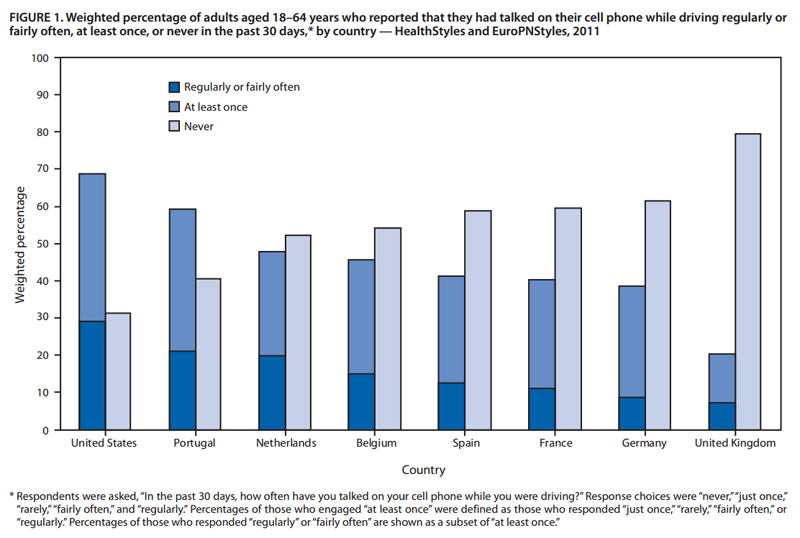
click to enlarge
To assess the prevalence of mobile device use while driving in Belgium, France, Germany, the Netherlands, Portugal, Spain, the United Kingdom (UK), and the United States, CDC analyzed data from the 2011 EuroPNStyles and HealthStyles surveys. Prevalence estimates for self-reported talking on a cell phone while driving and reading or sending text or e-mail messages while driving were calculated. This report describes the results of that analysis, which indicated that, among drivers ages 18–64 years, the prevalence of talking on a cell phone while driving at least once in the past 30 days ranged from 21% in the UK to 69% in the United States, and the prevalence of drivers who had read or sent text or e-mail messages while driving at least once in the past 30 days ranged from 15% in Spain to 31% in Portugal and the United States.
via Mobile Device Use While Driving — United States and Seven European Countries, 2011.
DO NOT LOOK AT THIS POST WHILE DRIVING
Filed under: Uncategorized | Tags: bicycle helmet laws, bicycle injuries, bicycle safety, bicycling injuries, Bike accidents, bike helmets, child cyclists, children and cycling, cycling, cycling injuries, helmet laws, helmets, mandatory helmet laws, transportation, urban cycling
Pinka Chatterji and Sara Markowitz, “Effects of Bicycle Helmet Laws on Children’s Injuries.” NBER Working Paper No. 18773. February 2013. JEL No. I0,K0
ABSTRACT
Cycling is popular among children, but results in thousands of injuries annually. In recent years, many states and localities have enacted bicycle helmet laws. We examine direct and indirect effects of these laws on injuries. Using hospital-level panel data and triple difference models, we find helmet laws are associated with reductions in bicycle-related head injuries among children. However, laws also are associated with decreases in non-head cycling injuries, as well as increases in head injuries from other wheeled sports. Thus, the observed reduction in bicycle-related head injuries may be due to reductions in bicycle riding induced by the laws.Pinka Chatterji
State University of New York at Albany Economics DepartmentSara Markowitz
Department of Economics Emory University
The auto industry loves mandatory helmet laws.
Filed under: Uncategorized | Tags: amnasty, amnesty, Amnesty shamnesty, blood doping, Boogerd, Dekker, doping, EPO, pro cycling, psychling, Rabobank
This is what those ‘amnesty’ deals will look like for pro riders:
Under the pact, Dutch riders and staffers have until April 1 to come clean on their respective pasts [but not completely clean, of course]. Riders or staffers who confess to doping practices prior to 2008 will be issued six-month bans and fined two months’ wages. More severe bans of up to four years would be imposed for those who don’t confess during the amnesty window, but are later exposed.
And if anybody confesses to doping after 2008, the entire world will explode. So don’t do that, riders.
This whole thing is completely ridiculous. Stick a fork in it.
via Velonews: Boogerd’s confession causes stir in Dutch teams.
Filed under: Uncategorized | Tags: Ben Jacques-Maynes, bicycle crash, bicycle racing, hit and run, Jamis, road rage, Sebastian Alexandre, Tuscon, Tyler Wren
Tyler Wren in VeloNews:
We departed for our ill-fated training ride on Friday at 10:00 a.m., headed out of town on Valencia Road, a common thoroughfare with a generous shoulder bounded by a white line. The 15-rider group was riding two-abreast in a long line, as far to the right as possible, in full accordance with Arizona traffic law. Our team’s strength and conditioning coach Todd Herriott and I were on the front, he on my left, closest to the passing traffic. Kinkade’s tan Oldsmobile Aurora suddenly and violently impacted Todd’s left side. He and I crashed hard on the front of the group as Mr. Kinkade sped away. My teammates also reported that Mr. Kinkade was shouting obscenities at us during the attack through his open car window.
As Todd and I lay on the ground struggling to comprehend what had happened, my unscathed teammate Ben Jacques-Maynes sprinted past us in an impressive pursuit of the fleeing car. Ben did not manage to catch the perpetrator, but he swiftly came upon our team car, which was waiting for us at our next turn and breathlessly explained the situation to our sport director, Sebastian Alexandre. Sebastian quickly resumed the pursuit along with his serendipitous passenger, John Segesta, a professional photographer in possession of a DSLR camera with a telephoto lens. John photographed numerous cars and license plates before the pair returned to the scene of the crime for the team members to positively identify the driver and vehicle.
John nailed him — crystal clear in high-definition on his camera was a shot of Kinkade’s car and Arizona license plate.
via Tyler Wren Journal: A first-hand account of the Jamis hit-and-run.
Filed under: Uncategorized | Tags: 2012, driving in the US, oil consumption, Peak Demand, Vmt
via http://www.fhwa.dot.gov/policyinformation/travel_monitoring/12dectvt/12dectvt.pdf
Filed under: Uncategorized | Tags: Alice Cooper, API, Eighteen, energy, oil demand, peak oil, petroleum demand, US oil consumption
18-year low oil demand. 18 million barrels per day.
18 and I like it.
U.S. Oil Demand Fell to 18-Year Low for January, API Says – Bloomberg.

Filed under: Uncategorized | Tags: Adelaide, bicycle accidents, bicycling, car-bike collisions, cycling safety, two-wheeled hellions, urban cycling
Drivers in Adelaide, according to a study of police reports there:
T-intersections were the most dangerous locations for crashes, followed by straight roads, and signalled intersections.
Drivers were at fault in 79 per cent of crashes and cyclists 21 per cent.
via Four in every five crashes between cars and bicycles caused by driver of car | adelaidenow.
Will this knowledge finally spark the crackdown on scofflaw cyclists that we so desperately need to finally cease any and all terrorizing of little old ladies by these unabashed two-wheeled hellions? Let us pray.
 Industrialized Cyclist Notepad