


Filed under: Uncategorized | Tags: crude oil production, energy, Forbes, global oil productionoil production statistics, JODI, KSA, OECD, oil production, OPEC, peak oil, production numbers, Russia, Russian energy ministry, russian oil, Russian oil production, Saudi Arabia, Saudi Arabian oil production
…between official Russian oil production numbers and JODI numbers.
via http://www.forbes.com/sites/markadomanis/2012/05/20/is-russian-oil-production-plummeting/

Filed under: Uncategorized | Tags: budget deficit, budget surplus, energy, Finland, GDP, Norway, peak oil, socialism, Sweden
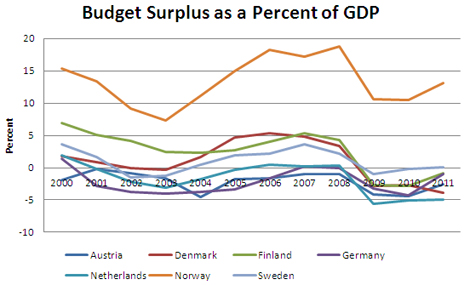
Not compared to N. American ‘capitalism.’ Despite the onslaught of talking heads and columnists sent to convince you otherwise. Many of you will find the reality of the situation very disappointing, but it is what it is.
Via Beat the Press: http://www.cepr.net/index.php/blogs/beat-the-press/david-brooks-self-doubt-and-self-confidence
Filed under: Uncategorized | Tags: Alberta tar sands, Canada, energy, ezra levant, foreign control of tar sands, oil sands, peak oil, tar sands, unconventional oil, Yergin
http://www.desmogblog.com/tar-sands-oil-companies-71-percent-foreign-owned-cue-ezra-levant-s-outrage

In a recent Bloomberg interview, Dan Yergin suggested we consider Canada as “not a foreign country,” thus oil from Canada is just like oil produced within the United States. Voila! Turns out oil from Canada is not even like oil from Canada.
Filed under: Uncategorized | Tags: ASPO, crude oil production, EIA, energy, Jeffrey Brown, oil production propaganda, peak oil, production numbers, Railroad Commission of Texas, RRC, Texas, Texas crude oil production, transportation
According to the Railroad Commission of Texas.
http://www.rrc.state.tx.us/data/production/oilwellcounts.php
Some individuals recently noting the difference between RRC and EIA production numbers. From a comment by Jeffrey Brown:
Total US Crude Oil Production (EIA, mbpd):
2002: 5.746
2003: 5.681
2004: 5.419
2005: 5.178
2006: 5.102
2007: 5.064
2008: 4.950
2009: 5.361
2010: 5.476
2011: 5.662Total US Crude Oil Production, using RRC data for Texas, instead of EIA (Gap Between the two data sets):
2002: 5.615 (+131,000 bpd)
2003: 5.548 (+133,000)
2004: 5.303 (+116,000)
2005: 5.059 (+119,000)
2006: 4.948 (+154,000)
2007: 4.898 (+166,000)
2008: 4.813 (+137,000)
2009: 5.199 (+162,000)
2010: 5.285 (+194,000)
2011: 5.324 (+338,000)
http://www.theoildrum.com/node/9191#comment-893345
Filed under: Uncategorized | Tags: energy, Fukushima, Fukushima Daiichi, Hiroaki Koide, nuclear accident, nuclear power, radiation, radioactivity, Tepco
Why should little kids have to eat it? An interesting moral dilemma.
クリーンな食べ物はない。
There is no clean food.
残念ながら福島の事故は起きてしまい、全地球に汚染を広げてしまっている。そのため、クリーンとか安全という食べ物というものはありません。
Sadly, the Fukushima accident happened, and has spread contamination throughout the world. So there is no food that is clean or safe.
ただし、猛烈に汚れている食べ物から比較的安全な食べ物まで、連続的に分布している。それをどのように受け入れるかが問題。
But there is a continuous variety of food from extremely contaminated food to relatively safe food. The issue is how to accept [allocate] such food.
猛烈な汚染食品は原子力を進めていた方々に食べてもらう。東電幹部、原子力を進めてきた政治家や、学者に食べてもらう。そういう仕組みを作りたい。
Extremely contaminated food should be eaten by people who have promoted nuclear power. TEPCO top management, and politicians and scholars who have promoted nuclear power. I would like to build such a system.
後は、原子力をここまで許してきてしまった大人たちに、汚染された食べ物を食べてもらって、子どもたちに汚染されていないものを食べさせてあげる。
The rest of the contaminated food should be eaten by adults, who have allowed nuclear power to this extent, so that the non-contaminated food goes to children.
via EX-SKF:
Filed under: Uncategorized | Tags: cornucopianism, doom porn, energy, Kunstler, peak oil, technology
Kunstler is always a fun read. Well-informed too. But he is a glass-half-empty kind of guy.
He’s got a new one coming out, apparently calling us out for our magical thinking about ‘technology,’ which is a good idea.

And there’s an interview on DisinfoCast here: http://www.disinfo.com/2012/04/too-much-magic-with-james-howard-kunstler-the-disinfocast-with-matt-staggs-episode-07/
Filed under: Uncategorized | Tags: Douglas, energy, fracking, Natural gas, natural gas drilling, Niobrara, Niobrara shale, shale gas, shale plays, tight gas, Wyoming
Niobrara fights back.
An oil well blowout in Wyoming prompted 50 residents to evacuate their homes amid concern that a spewing cloud of natural gas could explode.
Gas continued to erupt from the ground Wednesday after the blowout Tuesday afternoon five miles northeast of Douglas in east-central Wyoming. Witnesses told television station KCWY-TV they could hear the roaring gas from six miles away.
Residents evacuate after gas leaks from Wyo. well.
Filed under: Uncategorized | Tags: cars, DOT, dot gov, energy, FHWA, oil consumption, oil demand, Peak Demand, transportation, United States, vehicle miles traveled, Vmt
+ 1.8% Over Feb. 2011…
Moving 12-month total.
http://www.fhwa.dot.gov/policyinformation/travel_monitoring/12febtvt/12febtvt.pdf

Filed under: Uncategorized | Tags: crude oil, EIA, energy, Iran oil production, Iraq, middle-east, oil production, oil supply, peak oil, Peak Oil is dead, pipeline problems, Turkey
A new fire in the North Sea; blowout in Russia; hacking in Iran; pipeline problems in Turkey; accelerated violence in South Sudan… What I miss?
Filed under: Uncategorized | Tags: Apple, cloud, coal power, energy, green energy, internet energy consumption, internet power consumption, nuclear poer, renewable energy
… But some companies that essentially live on the Internet are moving facilities to North Carolina, Virginia, northeastern Illinois and other regions whose main sources of energy are coal and nuclear power, the report said. The report singles out Apple as one of the leaders of the charge to coal-fired energy.
…
Apple immediately disputed the report’s findings, saying that the company planned to build two huge renewable energy projects at its recently opened data center in North Carolina that would eventually offset much of the coal-fired and nuclear energy use.
But in a contrast that is sure to generate debate in the hypercompetitive marketplace of the Internet, the report asserts that a few other companies, including Google and Facebook, have demonstrated much more commitment to shifting some of their electricity demands to renewable sources like wind, solar energy and hydroelectric power.
via Online Cloud Services Rely on Coal and Nuclear Power, Report Says – NYTimes.com.
Filed under: Uncategorized | Tags: 7 sisters, de Margerie, energy, IEA forecast for 2012, Jon Thompson, Lee Raymond, oil demand, oil production, Peak Demand, peak oil, Total, XOM, Yergin
Interesting piece by Andrew McKillop.
At the current time there is no sign that either of these Nice Theory solutions coming about in the real world, unless we try the conspiracy theory that the OECD group, led by the US, Europe and Japan voluntarily sabotaged their economies in 2008 – to save oil !
Annual growth of oil demand by China, India, Bangladesh, Pakistan, Brazil, Turkey and other nonOECD, large population, oil importing industrialising countries could hit as much as 1.75 Mbd each year, under 2004-2007 global economic conditions. Not even 2 years of that growth would send oil prices right off the top of the graph. Even with continued slow oil demand growth by the OECD group, or recession-driven decline of their demand … global oil demand can easily bounce.
…
We can simply note that dependable Peak Oil denial from playful flyweights like Dan Yergin or oil industry stalwarts like former CEO Lee Raymond and E&P chief Jon Thompson of ExxonMobil, or Christophe de Margerie of Total has problems staying on track. The real bottom line on global oil production is increasingly heard: world oil output will very likely never achieve more than around 90 Mbd on a short-life basis, before terminal decline sets into operation. The only upside is that necessarily more expensive shale oil, and necessarily expensive GTL (oil from gas) may smooth the downslope.
Today’s IEA forecast for global average daily demand in 2012 is about 89.9 Mbd.
via The Magical Decline Of Crude Oil Demand :: The Market Oracle
Filed under: Uncategorized | Tags: AIS, China, China oil imports, Daily Star, energy, global oil trade, India, Iran, Iran oil, Iran oil exports, Iran oil production, Iran sanctions
It has long been assumed Iran would sell most of the oil shunned by Europe to China, its long-term strategic and commercial ally. But until now there has been scant proof.
India, however, has been buying oil on Iranian ships on extended credit for several months, industry sources say.
Filed under: Uncategorized | Tags: carbon, energy, fracking, methane, methane leakage, Natural gas, natural gas production, PNAS, radiative forcing, shale gas
Alvarez, Pacala, Winebrake, Chameides and Hamburg, “Greater focus needed on methane leakage from natural gas infrastructure,” Proceedings of the National Academy of Sceinces of the United States of America, 2012.
Full article: http://www.pnas.org/content/early/2012/04/02/1202407109.full.pdf+html
Filed under: Uncategorized | Tags: Cheniere, energy, fracking, hydraulic fracturing, liquefied natural gas, LNG, Natural gas, natural gas exports, shale gas, tight gas
Energy independence? Not so much.
The government may decide as soon as next week on Cheniere’s request to build a $10 billion Louisiana plant that would be the largest in the U.S. to liquefy gas and load it onto ocean-going tankers. Regulators will discuss the project April 19. Cheniere’s shares rose as much as 11 percent in New York.
via LNG Export Plant Verges on U.S. Approval Amid Shale Glut – Bloomberg.
Filed under: Uncategorized | Tags: denial, economics, energy, joules, Peak Demand, peak oil, physics, thermal energy, Tom Murphy, waste heat
Or, My Dinner With Andre the Giant Economist.
Another fun bit from Tom Murphy. Shades of Plato’s Republic.
…The upshot is that at a 2.3% growth rate (conveniently chosen to represent a 10× increase every century), we would reach boiling temperature in about 400 years. [Pained expression from economist.]
via Exponential Economist Meets Finite Physicist | Do the Math.
The economist says he believes that energy will become “arbitrarily cheap” in the future, before realizing how stupid that is.
Filed under: maps, Uncategorized | Tags: congressional research service, CRS, energy, petroleum, strategic petroleum reserve
(Congressional Research Service)
(Strategic Petroleum Reserve)
Via http://www.fas.org/sgp/crs/misc/R42460.pdf

click to enlarge
I believe they reversed or will reverse the Seaway.
Filed under: Uncategorized | Tags: Citi, Citigroup, energy, fracking, hydraulic fracturing, oil price predictions, oil supply, oil supply predictions, peak oil
Citi analysts have been calling an end to America’s energy problems and for the appearance of a 900-foot-tall golden unicorn named Darren.

Filed under: Uncategorized | Tags: Alaska, deepwater, energy, fracking, GOM, Gulf of Mexico, horizontal drilling, hydraulic fracturing, North Slope, Prudhoe Bay, shale gas, tight gas, tight oil, unconventional oil
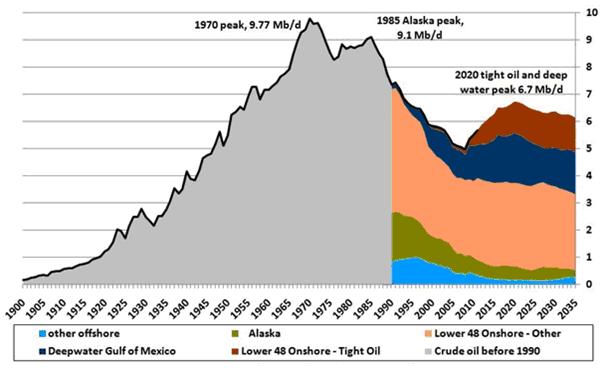
From EIA. Prudhoe Bay also “reversed the decline in domestic oil production” at one point.
click to enlarge
Filed under: Uncategorized | Tags: energy, Japan, offshore wind energy, renewable energy, turbines, wind energy, wind power, wind turbines, windmills
Floating windmills offshore Japan.
The biggest challenge in erecting floating turbines offshore is ensuring the buoyancy mechanisms are stable, and getting fixed lines to the sea floor which can be extended to depths of 200 meters (656 feet).
via Floating Windmills in Japan Help Wind Down Nuclear Power: Energy – Bloomberg.
Filed under: Uncategorized | Tags: Baker Hughes, drilling rigs, Early Warning, energy, fracking, gas production, Natural gas, oil production, Staniford
via Stuart Staniford’s Early Warning:
http://earlywarn.blogspot.com/2012/03/us-rig-count-trends.html

 Industrialized Cyclist Notepad