


Filed under: maps | Tags: Indianapolis, Joan Hostetler, transportation, urban cycling, urban development, urban freeways
In Indianapolis and elsewhere. Here is a current map of some Indy freeways superimposed over a 1956 aerial photo.
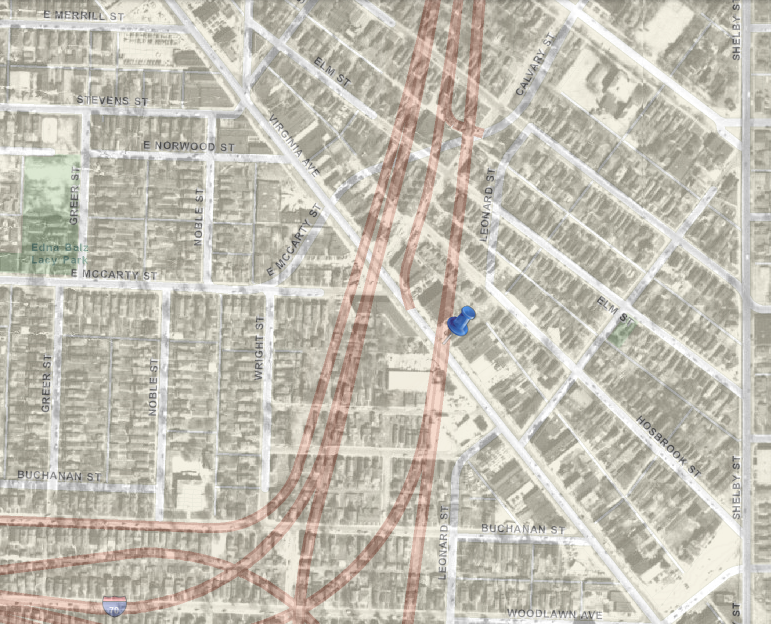 click to enlarge
Filed under: Uncategorized | Tags: Beyonce, Beyonce Knowles, bicycling, Brooklyn Bridge, NYC, urban cycling
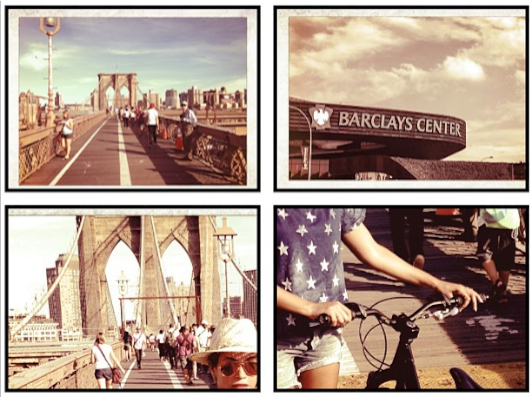
“…It’s amazing how I’m able to ride around on a bike. People kind of see it’s me but since I’m on a bike, they think, ‘No, it’s not her.’ And by the time they realize it’s me, I’m already gone.”
via Gets It: Beyoncé Bikes to Barclays | Streetsblog New York City.
Filed under: Uncategorized | Tags: bicycling, Boise, Idaho stop, stop as yield, urban cycling
The City of Boise Cycling Safety Task Force, 2009, composed mostly of law enforcement officials:
…Moreover, the Task Force largely agrees that bicycles, by nature of their mass, speed, maneuverability and lack of protection for the rider, are sufficiently different from automobiles to deserve separate treatment under the law.
CITY OF BOISE CYCLING SAFETY TASK FORCE FINAL REPORT 2009 (pdf).
Thanks to Rick Price for showing me this.
Filed under: Uncategorized | Tags: bicycling, biking, cycling, Fort Collins, Idaho stop, Rick Price, stop as yield, urban biking, urban cycling
But I think it’s time we talked about the feasibility of allowing cyclists to treat stop signs as yield signs. This would solve a lot of problems and create some opportunities.
via Price: Do cyclists really need to stop at stop signs? | The Coloradoan | coloradoan.com.
It would probably cause some problems too, but would be an overall positive.
Deliberate signal infractions by bicyclists aren’t nearly as dangerous as people think, or as dangerous as people would like. The evidence is overwhelming.
Right on, Rick.
Filed under: Uncategorized | Tags: bicycle parking, bicycling, bike parking, Choo, Eco Cycle, Giken, Japan, transportation, urban cycling
Via Danny Choo:

…construction company Giken have come up with a solution which stores hundreds of bicycles underground using a system called Eco Cycle – a robot system which stores bicycles underground in a 11 meter deep well.
via Japan Underground Bicycle Parking Systems.
Filed under: Uncategorized | Tags: bicycle, bike, bike share, biking, cycling infrastructure, Friedersdorf, NYC, Rabinowitz, urban cycling, WSJ
That’s right, Friedersdorf.
There is no one in America who objects more consistently than me to Mayor Michael Bloomberg’s initiatives: This is a man who favors stop-and-frisk, racially profiling and spying on innocent Muslims, restricting the size of soda New Yorkers can buy, salt limits, a trans-fat ban, and a pervasive surveillance state. Left up to me, no one like Bloomberg would ever exercise political power. My disdain for his paternalism and disregard for civil liberties is what inclines me to defend his bike initiative. It is the least “totalitarian” major initiative that Bloomberg has undertaken, yet is denounced with some of the strongest language. If the critics were merely expressing their personal displeasure at the prospect of cities better suited to bike travel (or doubts about the efficacy of a particular policy aimed at making cities more bike friendly) that would be fine. Instead they co-opt the language of freedom and oppression, as if orienting cities toward automobiles is natural and libertarian, while bike shares and bike lanes are harbingers of tyranny.
That is vapid, paranoid, philosophically incoherent nonsense. By frivolously trafficking in it, I fear that Rabinowitz and friends will diminish all warnings about liberty and government overreach. Even the boy who cried wolf was invoking the specter of an actually frightening creature.
via The Paranoid Style in Bicycle Politics: A Bicoastal Freak-Out – Conor Friedersdorf – The Atlantic.
Filed under: Uncategorized | Tags: bicycling, bike commuting, Books, Robert Hurst, urban cycling
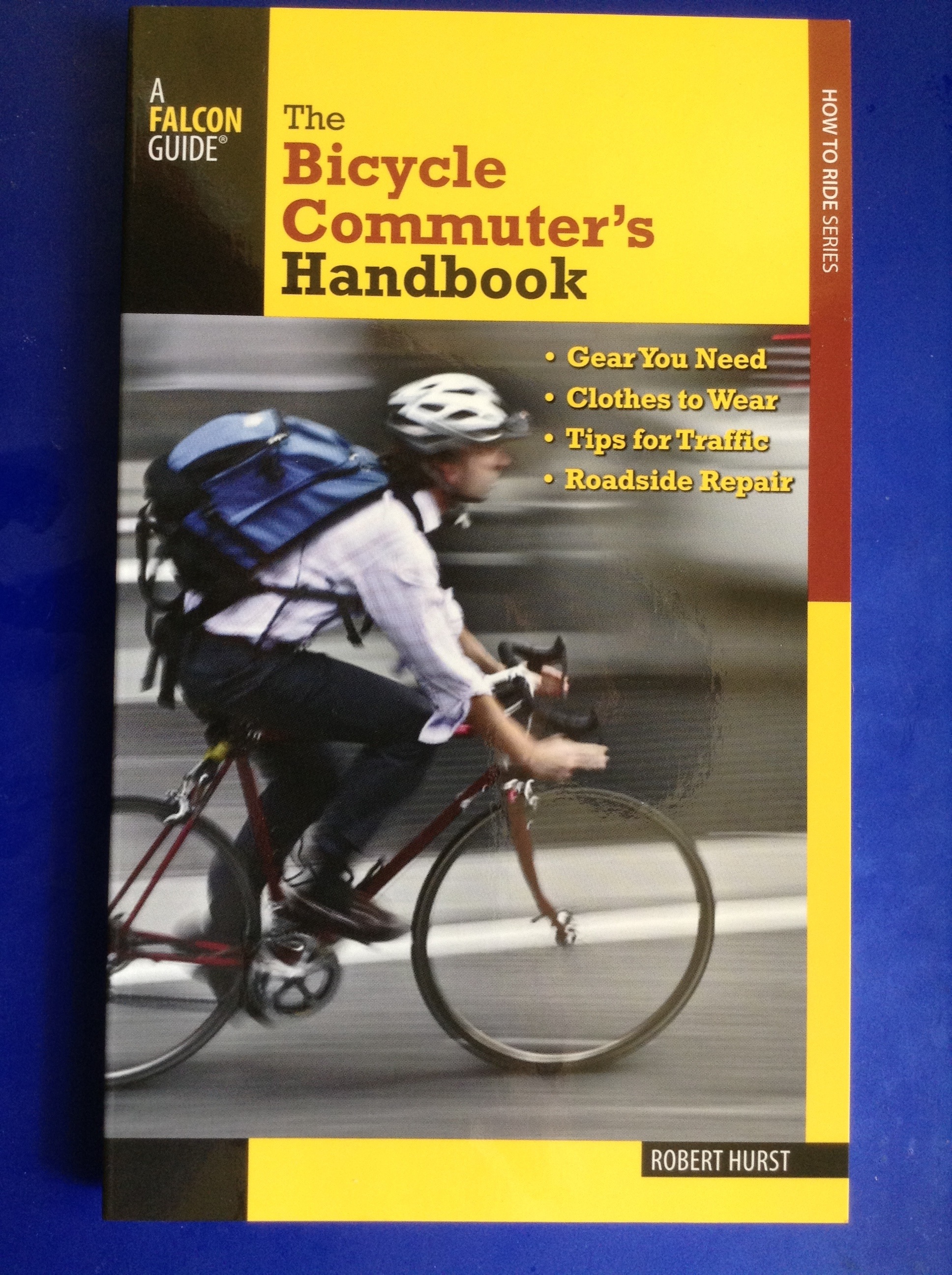
The Bicycle Commuter’s Handbook by Robert Hurst
Filed under: Uncategorized | Tags: bicycling, bicycling advocacy, Cyclist's Manifesto, EVs, evworld, history of bicycling, Prius, urban cycling, urban mobility, Viet Cong, women's liberation
I appreciate the shout out from evworld.com, but fear what might happen when they reach the Prius chapter.
Writing about the “simple fun” of riding a bicycle in “The Cyclist’s Manifesto,” Robert Hurst put the technology in historical perspective, stating:
“Fun is apolitical. Fun has no agenda, other than to make you smile. And yet even the person who climbs onto a bike for the simple purpose of having fun or getting a whiff of fresh air will be saddled with the baggage of history, accompanied by a cloud of suspicion hanging around a machine that has at various times been intimately associated with women’s liberation, white power, political sneakiness, Asian communism, sabotage and spying and other rebel mischief, the Viet Cong, European socialism, illegal immigration, serial drunk drivers, anarchy, privilege, anti-car fanaticism, and multiple manifestations of youthful antiestablishment activities. This mishmash of historical symbolism is now woven into the collective subconscious of the nation. The bicycle is loaded.”
Until reading “Manifesto,” I had no idea that such an elegant and efficient machine carried so much historical baggage from across such a wide political and philosophical spectrum, from revolutionary communism to the epitome of capitalism, Henry Ford, himself, whose first ‘automobile’, the Quadracycle,’ was built largely from repurposed bicycle parts.
via Seven Solid Reasons Conservatives Should Love Bicycles : URBAN MOBILITY ON EVWORLD.COM.
Filed under: Uncategorized | Tags: bicycle, bicycling, bike rental, bike share, Citi, Citi Bike, Citibank, Citibike, end of the world, helmet, helmets, New York, New Yorker Magazine, NYC, slow rollout, stationary bicycle, transportation, urban cycling
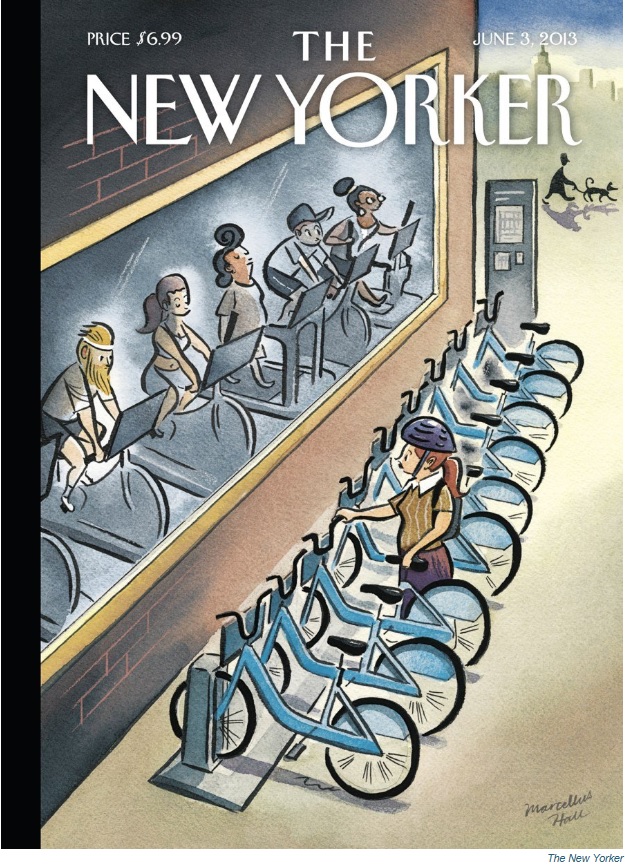
Painfully slow rollout of NYC’s Citibike rental scheme is here, maybe. Lock up your daughters!
Interesting the artist put a helmet on the outside rider. Wonder if he/she was told to do that.
via http://publicbikeshare.com/2013/05/28/public-bike-share-a-picture-says-1000-words/
Filed under: Bike of the Day | Tags: apehangers, bicycle, cruiser bike, cycling, Schwinn, urban cycling


Cruiser style frame, apehanger bars and 10 speeds.
Filed under: Uncategorized | Tags: bicycle helmets, bicycling, Costco Connection, cycling, FalconGuides, helmets, Hurst, Karen Bannan, Robert Hurst, The Bicycle Commuter's Handbook, urban cycling, USCPSC
Big Time Stuff, y’all.
Costco Connection – May 2013 – Page 48-49.
…Some helmets offer more protection, with harder shells and fewer ventilation holes, but will not be as comfortable for long rides, says Robert Hurst, the author of several bicycle-related books, including The Bicycle Commuter’s Handbook (FalconGuides, 2013). “You don’t need to spend a ton of cash to get a decent helmet, but steer clear of bargain-bin knock-offs that haven’t been certified by the U.S. Consumer Product Safety Commission,” he says.
Filed under: Uncategorized | Tags: bicycling, bike-friendly states, cycling, cycling infrastructure, green transportation, LAB, LAW, League of American Bicyclists, League of American Wheelmen, transportation, transportation policy, urban cycling

via League of American Bicyclists (pdf): http://bicyclecolo.org/merchant/117/files/2013BFSrankingchart.pdf
Filed under: Uncategorized | Tags: bicycle accidents, bicycle crashes, bicycling injuries, crashtastic, justice breyer, stephen breyer, Supreme Court, urban cycling
WASHINGTON (AP) — Supreme Court Justice Stephen Breyer is in a Washington hospital after shoulder replacement surgery following a bicycle accident.
[…]
Breyer injured his right shoulder in a fall Friday near the Korean War Veterans Memorial.
The justice previously broke his collarbone in an accident in 2011 and sustained broken ribs and a punctured lung in a bicycle mishap in 1993, before he joined the court.
via Breyer has shoulder surgery after bike accident – Yahoo! News.
Filed under: Uncategorized | Tags: bicycling infrastructure, Boettcher Mansion, denver, hit and run, local government, traffic accidents, urban cycling, vulnerable road users
Not yet sure what that means. Could be good or bad, probably a combination of good and bad.
Denver City Council met for several hours Friday morning at the scenic Boettcher Mansion atop Lookout Mountain, agreeing that pedestrian and bicycle safety should be among the city’s the top budget priorities for 2014.
[…]
Recent high-profile hit-and-run crashes that have killed pedestrians and increasing interest in creating a more walkable and bike-able Denver prompted the council to order the budget office focus on improving the city’s pedestrian and bicycling infrastructure.
via Denver City Council sets budget priorities for 2014.
Filed under: Uncategorized | Tags: auto traffic, auto-pedestrian, bicycle, bicycling, bike, car-pedestrian, collisions, denver, Denver-Boulder, hit and run, traffic accidents, transportation, urban cycling
Denver’s traffic not following national trends.
Denver’s auto-pedestrian accidents were up 46 percent for the first eight weeks of 2013 over the previous two years. Another grim statistic also stands out: Last year, the city had 13 hit-and-run fatalities, more than the previous three years combined.
[…]
After two years of averaging about 31 auto-pedestrian incidents a month, the average jumped to 44 a month in January and February, according to Denver police statistics.
Hit-and-run cases averaged 8.5 a month in January and February — after 4.8 per month in 2011 and 6.1 in 2012.
[…]
Over the past decade, about 1,600 accidents involving pedestrians or cyclists were reported every year, according to a study by the Denver Regional Council of Governments.
In the 10-county region, 17 percent of all fatalities were pedestrians, and 3 percent were cyclists.
via Spike in Denver's auto-pedestrian cases has officials seeking answers – The Denver Post.
These “jumps” are based on a mere two months’ of accidents. Gotta keep an eye out to see if it continues.
Filed under: Uncategorized | Tags: Belgium, CDC, distracted driving, EuroPNStyles, France, HeathStyles, little screens, mobile device use while driving, Portugal, Spain, texting while driving, twiddlin your screen, UK, urban cycling, watch the road
USA! USA!
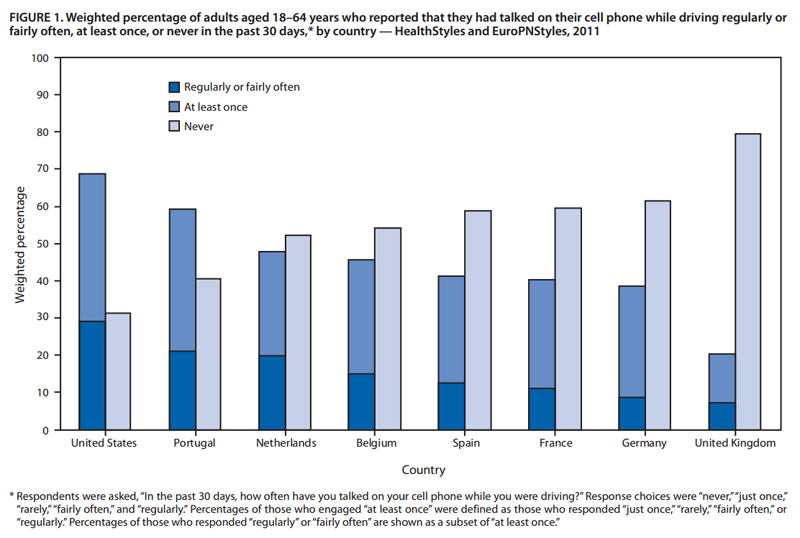
click to enlarge
To assess the prevalence of mobile device use while driving in Belgium, France, Germany, the Netherlands, Portugal, Spain, the United Kingdom (UK), and the United States, CDC analyzed data from the 2011 EuroPNStyles and HealthStyles surveys. Prevalence estimates for self-reported talking on a cell phone while driving and reading or sending text or e-mail messages while driving were calculated. This report describes the results of that analysis, which indicated that, among drivers ages 18–64 years, the prevalence of talking on a cell phone while driving at least once in the past 30 days ranged from 21% in the UK to 69% in the United States, and the prevalence of drivers who had read or sent text or e-mail messages while driving at least once in the past 30 days ranged from 15% in Spain to 31% in Portugal and the United States.
via Mobile Device Use While Driving — United States and Seven European Countries, 2011.
DO NOT LOOK AT THIS POST WHILE DRIVING
Filed under: Uncategorized | Tags: bicycle helmet laws, bicycle injuries, bicycle safety, bicycling injuries, Bike accidents, bike helmets, child cyclists, children and cycling, cycling, cycling injuries, helmet laws, helmets, mandatory helmet laws, transportation, urban cycling
Pinka Chatterji and Sara Markowitz, “Effects of Bicycle Helmet Laws on Children’s Injuries.” NBER Working Paper No. 18773. February 2013. JEL No. I0,K0
ABSTRACT
Cycling is popular among children, but results in thousands of injuries annually. In recent years, many states and localities have enacted bicycle helmet laws. We examine direct and indirect effects of these laws on injuries. Using hospital-level panel data and triple difference models, we find helmet laws are associated with reductions in bicycle-related head injuries among children. However, laws also are associated with decreases in non-head cycling injuries, as well as increases in head injuries from other wheeled sports. Thus, the observed reduction in bicycle-related head injuries may be due to reductions in bicycle riding induced by the laws.Pinka Chatterji
State University of New York at Albany Economics DepartmentSara Markowitz
Department of Economics Emory University
The auto industry loves mandatory helmet laws.
Filed under: Uncategorized | Tags: Adelaide, bicycle accidents, bicycling, car-bike collisions, cycling safety, two-wheeled hellions, urban cycling
Drivers in Adelaide, according to a study of police reports there:
T-intersections were the most dangerous locations for crashes, followed by straight roads, and signalled intersections.
Drivers were at fault in 79 per cent of crashes and cyclists 21 per cent.
via Four in every five crashes between cars and bicycles caused by driver of car | adelaidenow.
Will this knowledge finally spark the crackdown on scofflaw cyclists that we so desperately need to finally cease any and all terrorizing of little old ladies by these unabashed two-wheeled hellions? Let us pray.
Filed under: Uncategorized | Tags: conspicuity, high-vis, looked but failed to see, urban cycling
Helman, Weare, Palmer and Fernandez-Medina, “Literature review of interventions to improve conspicuity of motorcyclists and help avoid ‘looked but failed to see’ accidents,” 2012.
A really nice overview of motorcyclist conspicuity studies, with this nugget at the very end:
Special thanks are due to Cris Burgess for reviewing an earlier draft of this report. During the period of time when reviewing the draft, Cris was riding his motorcycle to work and was struck from behind by a bus. Thankfully, Cris sustained only minor injuries in the collision. The irony of the fact that at the time of the collision he was wearing a bright orange high-visibility jacket, and riding a motorcycle with daytime running lights, is not lost on the authors.
Using lights during the day, wearing hi-vis clothing, helps. It does not work reliably, however, as the effectiveness of the extra measure(s) will depend very much on the background and other aspects of the immediate environment, which are constantly changing.
 Industrialized Cyclist Notepad